
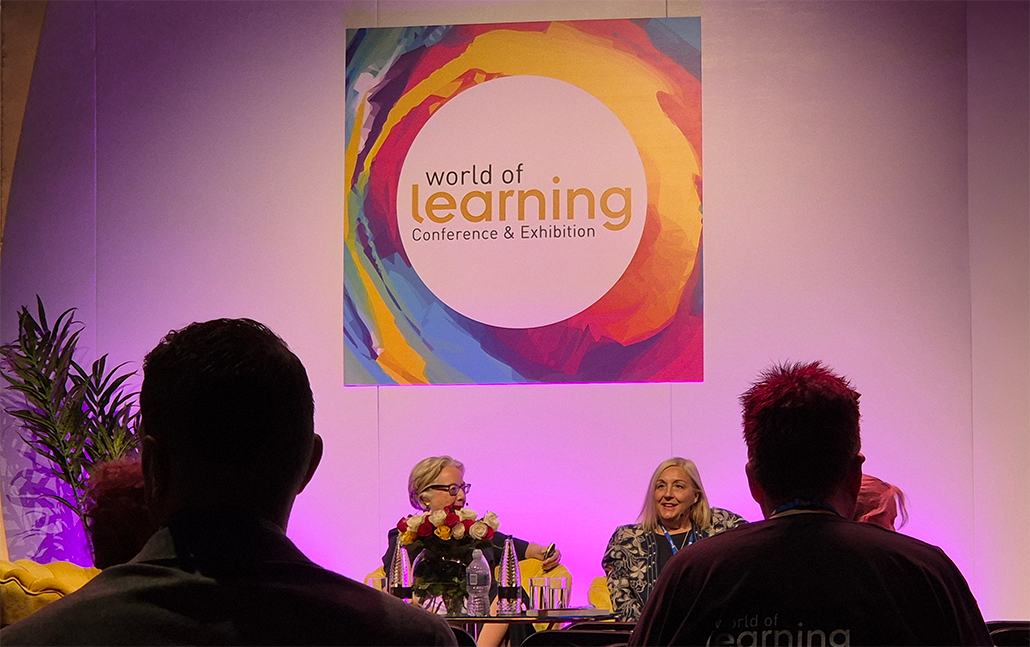
L&D is undergoing its biggest shift in decades. At World of Learning 2025, 17 experts shared bold, insightful answers on what’s coming next. From AI to skills strategies and culture shifts, Kirstie Greany explores what the profession must prioritise to stay human, strategic and impactful over the next five years.
Learning and development as an industry is at a turning point, a tipping point, or is that an inflection point? If the conversations at this year’s World of Learning Conference were anything to go by, L&D is facing its biggest reinvention in decades. And for many, this is exciting and uncomfortable.
To dig into this, I asked 17 conference speakers three bold questions:
- What’s the most exciting, or terrifying, way technology is reshaping learning?
- In five years, what will L&D not survive without?
- What trend should L&D double down on next year?
The answers were diverse yet connected by a shared undercurrent of change. Laura Overton commented that, “L&D teams are going to need to have shifted their thinking… given up on the things they’re frightened of and been willing to reimagine their own personal role.” Here’s a distilled tour of the key ideas shared.
Exciting or terrifying? The double edge of AI
Experts were excited by AI’s potential for personalised learning, richer data, and freeing time for more complex work. Avinash Chandarana commented that we can now “reshape learning” so it “becomes far more personalised and contextualised to what I do every single day”.
But there’s a flipside. AI can hollow out human connection, which Aimee Young calls “terrifying” and has the potential to “reduce our ability to think critically.” Robin Hoyle warns of scaling up the wrong things and that using AI “just to churn out more content is a waste of its potential.”
L&D must guide people to think critically and ethically about AI, rather than chasing every shiny new tool
Geraldine Voost
And then there’s employee well-being, a major theme led by conference keynote speaker, Thimon de Jong. He argues throwing in tech and AI without focusing on this first, can stall learning altogether. This was echoed by others, with Geraldine Voost warning, “L&D must guide people to think critically and ethically about AI, rather than chasing every shiny new tool.”
As L&D leaders wrestle with AI, it seems we should ask:
- How can it help us solve real human problems?
- Are we scaling the right solutions for the right audiences?
- What impact are our choices having on mental and emotional wellbeing?
What L&D won’t survive without…
What will be indispensable for L&D in the next five years? Experts offered bold perspectives. Sarah Linsell of PWC: “L&D needs to completely reinvent itself – how it delivers everything and how it approaches learning.” Jo Cook, Editor of Training Journal, emphasises, “We need design thinking, horizon scanning, and the ability to synthesise the broader landscape, rather than just focusing on ‘learning’.”
As L&D professionals seek a new strategic focus, data emerges as crucial. Robin Hoyle notes, “You can’t intelligently automate or demonstrate impact without it.” Others advocated for prioritising human connection and fostering nurturing learning environments. Ad Davies stated: “Human connection is the fundamental driver that will never be replaced in our workplaces.”
While James Swift champions AI coaching, he warns, “If you’re unable to do growth coaching and mindset coaching yourself, you’ll be redundant.” This underscores the importance of automating or scaling only what is proven effective. Past playbooks need not apply. Instead, the future demands L&D leaders who are curious, connected, and courageous.
What to double down on next year
As L&D looks toward 2026, leaders are clear on where to focus to make real impact. Personalised, skills-based learning sits at the top of the agenda: Jade Mountain champions diverse, bespoke approaches, while Penny Simpson stresses, “Go all in on skills, as that drives the business bottom line.”
Equally important is prioritising initiatives that truly move the needle. Melanie Martinelli advises, “Put your effort into those things that make the difference,” cutting back on low-impact activity.
AI continues to offer promise when applied strategically. Peter Manniche Riber suggests using intelligent agents to automate routine tasks, freeing teams to tackle high-value work.
Meanwhile, culture and psychological safety remain central: James Swift and Chris Baldwin highlight the need for safe spaces where people can “fail hard and learn from experience.”
With the future role of L&D still in flux, deciding where to focus comes down to a simple question: what does your business need you to be?
Becoming the organisational nervous system
Opinions are varied, but one thing is clear: the future isn’t about content (was it ever?) or control. L&D must become the organisational nervous system, sensing needs, transmitting insights, and coordinating capability across every layer of the business. It requires systems thinking, designing for adaptability, and building feedback loops fed by data that keep learning alive and focused.
This is just a taste, you can watch the full expert discussions (below) to explore the ideas in depth.
Kirstie Greany is Head of Learning Strategy at Elucidat
Contributors include: Ad Davies (exGymshark), Aimee Young (UCL), Andy McConville (ResQ), Avinash Chandarana (MCI Group), Chris Baldwin (Independent), Geraldine Voost (Justitiële Informatiedienst), Jade Mountain (London Business School), James Swift (Leyton UK), Jo Cook (Training Journal), Laura Overton (Learning Changemakers), Marina Mologni (Atlas Copco Group), Melanie Martinelli (Institute for Transfer Effectiveness), Penny Simpson (Inriver), Peter Manniche Riber (exNovo Nordisk), Robin Hoyle (Chair of World of Learning), Sarah Lindsell (PwC), and Thimon de Jong (Whetston)
