
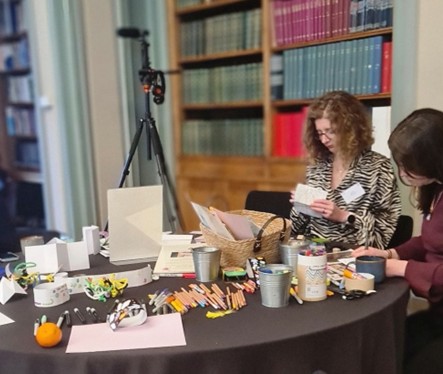
Conference days can feel like a firehose: keynotes, chats, slides, then a tired journey home and a notebook nobody opens. AMC Newton and Amelia Wakeford show how intentional reflection breaks overload, helping brains consolidate learning. Their Creative Download approach uses calm pauses and hands-on making to turn insights into actions.
We’ve all been there: train home from a conference, notebook full of insights, determined to implement everything. Days later, that notebook sits unopened. Weeks later, we struggle to remember what the keynote was even about.
We invest heavily in conference attendance, yet struggle to retain or apply what we learn not because the content isn’t valuable, but because events don’t build in time to process, reflect, and integrate
“Reflection is essential for professional competence development in every profession” – Alberto A. P. Cattaneo. This quote is taken from a blog that Jo Cook, Editor of Training Journal, wrote ahead of the TJ@60 event. Jo referenced Ed Bernacki’s observation that conference goers often make notes and never look at them again. Jo took a bold decision: sacrifice speaker slots for reflection time.
We were invited to help bring this vision to life through our offer Creative Download, which is dedicated reflection spaces combined with creative activities.
Our design: Creative Download
We created calm transition points for participants to pause, process, and personalise their learning. Our aim was to reduce overwhelm whilst supporting deeper reflection, so ideas from the event could translate into meaningful insights and future actions.
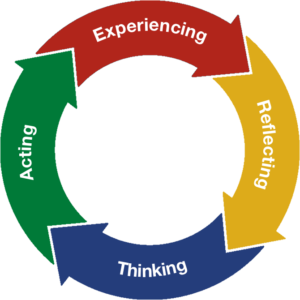
The approach was grounded in both learning theory and neuroscience. Kolb’s Experiential Learning Cycle shows that deep learning requires experiencing, reflecting, thinking, and acting. Conferences provide experience but skip reflecting. Creative Download fills that gap.
www.experientiallearninginstitute.org
Used with permission
Brain science supports this: the Default Mode Network, active during rest, plays a key role in memory consolidation and reflective thinking . We also drew on embodied cognition research showing that when the brain, body, and environment act together through physical engagement, learning improves. That’s why we offered creative materials: hands-on engagement helps shift thinking into more associative, idea-generating states.
We designed three touchpoints: a creative arrival moment, a midday reflection space with options to write, doodle, or observe quietly, and an end-of-day session combining reflection with action planning.
What we learnt
The feedback validated our approach. Participants noted the session as an “oasis of me time” for personalising learning, appreciating the opportunity to ‘do something different’ and the value of choice. This included using art materials, going for a walk, having a conversation, simply sitting quietly or whatever was best for that person in that moment.
Perhaps most telling was this comment: “I wasn’t sure about this session at first but then grew to love it. Freeing up our minds to be creative was a challenge but once I gave it a go, it was great.” Others echoed similar appreciation for having dedicated time to think and reflect.
We also encountered that using the word ‘creativity’ itself can be polarising. Despite being fundamental to human experience, the word provokes strong reactions, both positive and negative. Working with art materials and having ‘creative’ in our tagline means addressing stereotypes about ‘creative types’ and brings up people’s personal defences. Without strong upfront framing, some participants struggled to connect creative reflection with serious professional development.
We learned that framing matters: leading with the evidence and business case before the experiential element will make future Creative Download sessions even more impactful.
Tips for designing a creative reflection session:
Based on this learning, and acknowledging that this is an iterative process, here’s what we are evolving Creative Download to include:
- Frame the why first
Start with: “Here’s why your conference notes go unread.” Share the brain science of the Default Mode Network. Make the business case explicit before offering the experiential session. - Make it opt-in
Create a separate reflection zone that doesn’t compete with the main programme or networking. Let people choose to engage. - Time it strategically
Position Creative Download at points when brains are full and participants genuinely need time to process and consolidate. - Offer structure within choice
Provide guided pathways alongside open creativity. Some people thrive with blank pages; others need prompts and frameworks. - Positioning
This isn’t a “nice to have”, it’s serious learning design, grounded in Kolb’s experiential learning theory and neuroscience research.
The core insight remains valid: if we forget so much with passed time and inaction, reflection time isn’t a luxury: it’s essential for maximising the significant investment organisations make in professional development.
An invitation
The irony isn’t lost: we design learning experiences for others with reflection built in, yet our own conferences remain content marathons. Jo’s experiment at TJ@60 proved the appetite is there. If you’re organising L&D events and want to build reflection in by design, we hope this has proved inspirational and that we can continue to learn from each other.
AMC Newton is a Creativity Trainer & Facilitator at Creative Orange Studio
Amelia Wakeford is a Creativity Facilitator at Creative Can
Together they form Creative Download: a facilitation duo who design reflective, creative spaces for people to think, feel, and sense their way through complex work
