
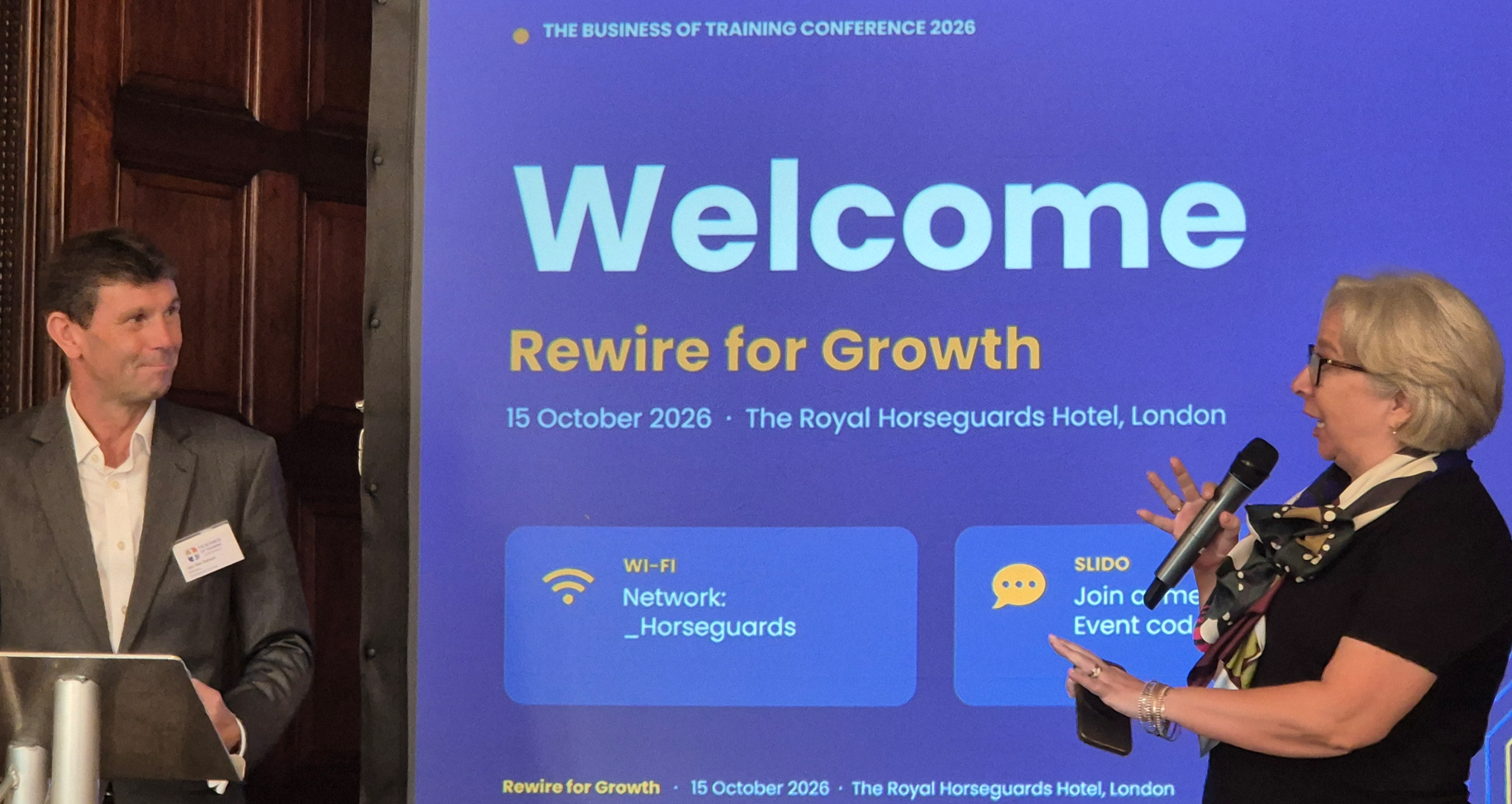
AI, changing customer expectations and increasing pressure to demonstrate value are challenging traditional training business models. Reflecting on the Business of Training Conference 2026, Jo Cook explores the importance of understanding customer needs, designing learning for workplace performance and identifying what makes training providers genuinely distinctive in a competitive market.
What gives your training business the right to exist?
It’s a provocative question, but it’s one that stayed with me after attending the Business of Training Conference in London on 15 October. Organised by Inmisceo, the conference brought together training providers, business leaders and industry experts to explore how the industry can adapt and grow.
What struck me was how often the conversations returned to some fairly fundamental questions
The theme was Rewire for Growth, and across the day there was plenty of discussion about AI, customer needs, business strategy and demonstrating value. What struck me was how often the conversations returned to some fairly fundamental questions. Who are we serving? What problems are we solving? What makes us different? And how do we know we’re making a difference?
These aren’t new questions, but perhaps the changing training market means we need to take them more seriously.
Relevance is a matter of survival
Donald H Taylor opened his keynote with a picture of a PDP-11 mainframe computer, a machine he had worked with earlier in his career, now housed in the National Museum of Computing.
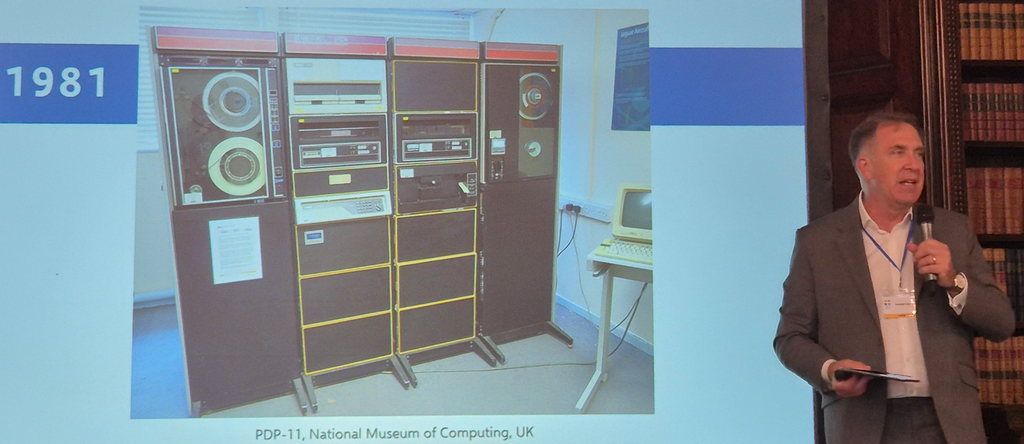
It was an interesting way to illustrate just how much technology has changed. But Don also highlighted some of the things that haven’t changed, including the importance of metrics, tight margins and understanding the business you’re operating in.
Drawing on his Global Sentiment Survey, Don explored how the language used by L&D professionals has shifted over time. One word that stood out was ‘pressure’. Its use appeared to decline after the global pandemic, only to increase again following the arrival of ChatGPT.
That’s hardly surprising given that the profession is facing significant questions about AI, its value to organisations and even what L&D itself might become. Don suggested we could see L&D dividing into two broad areas: one more strategic, the other highly tactical.
I was particularly interested in another change in the survey data. Words such as ‘analysis’, ‘data’ and ‘research’ have become more prominent since 2023. Could this indicate a shift towards more evidence-informed practice? I’d certainly like to think so.
Despite the pressures, Don’s message also recognised the opportunities that come with significant change. The challenge is how we respond.
Stop selling solutions to problems customers don’t have
A panel discussion with Malcolm Taylor, Caroline Radcliffe and Ian Nickson explored partnerships and what training customers actually need. One of the biggest mistakes identified was arriving with a solution to a problem the customer doesn’t have.
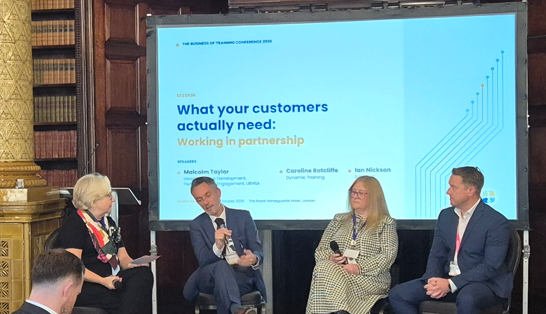
It sounds obvious, doesn’t it? Yet we’re frequently encouraged to market our businesses by talking about the problems we solve. That advice only works if we’ve taken the time to understand those problems properly. A training provider might have an excellent programme, platform or methodology. But if it doesn’t address what the customer is trying to achieve, why should they buy it?
The panel also explored trust, particularly what happens when technology or processes fail. Customers need partners who will work through challenges rather than disappear when things become difficult.
One panellist shared a personal experience of discovering they had dyscalculia at university and the difference made by a lecturer who refused to give up on them. That story was a useful reminder of the human element in what we do.
There was also a call for greater business acumen among training providers. We’re contributing to organisational performance, and understanding the business context is essential. It’s a theme I return to regularly at TJ, and base our own 2027 conference around it. Understanding what our customers need means understanding their organisational priorities, pressures and measures of success.
If AI can replicate your product, what makes you valuable?
Andy Lancaster explored how AI is levelling the playing field for individuals, organisations and their customers. Traditional training products are increasingly vulnerable to replication. Content creation, learning resources and aspects of delivery can now be produced using tools that are becoming more accessible and capable.
So where does that leave training providers? Andy offered four areas on which providers should focus:
- Problem solving
Concentrate on business challenges rather than technologies or products - People
Build relationships, trust and support people through uncertainty and change - Possibilities
Help customers imagine and achieve things they couldn’t accomplish alone - Proof
Demonstrate impact using measures that matter to the organisation, rather than relying solely on learning metrics
That final point is particularly important. It’s easy to report how many people attended training, completed a course or enjoyed the experience. Those measures have their uses, but they don’t necessarily tell us whether the training has made a difference to performance.
And if AI makes producing training content easier and cheaper, demonstrating that difference becomes even more important.
Design for the job people actually do
Juliette Denny continued the conversation about distinctiveness, focusing on who learning is designed for and why people need it. Her contribution prompted another important question: are our learning experiences genuinely designed around the work people need to do?
We need to consider different learner needs, the context of their roles and the capabilities they must apply. Juliette also challenged us to think about whether AI helps or hinders people’s thinking. Are we creating systems that support analysis, application and decision-making? Or are we simply making it easier for people to access information without developing the capability to use it?
It’s a distinction worth exploring. My reflection from the session was that training needs to be mapped much more closely to the jobs people actually do. Adults need to get to application, analysis and execution within their roles. Yet much technology-enabled learning still focuses heavily on delivering information and encouraging knowledge retention.
Yes, we absolutely need to build knowledge. But knowing something and being able to use it effectively at work are different outcomes. If we want to make a meaningful contribution to performance, our learning design needs to reflect that difference.
What gives your business the right to exist?
Ben Pike’s contribution on business growth brought the discussion back to some deceptively straightforward principles:
- Know who your customers are
- Understand the value you provide
- Be clear about what makes your organisation distinctive.
And ask yourself what gives your business the ‘right to exist’.
What interested me was Ben’s observation that the advice he gives businesses about growth is often relatively simple in principle. The greater challenge is making the investment and decisions needed to act on it, something many of us can recognise. Knowing that we should understand our customers is one thing. Investing time in meaningful conversations, research and analysis is another.

Knowing that we should differentiate our businesses is straightforward. Identifying what genuinely makes us distinctive, rather than simply describing ourselves with familiar marketing language, takes considerably more thought. For training providers, this is becoming increasingly important. If another provider can offer a similar course, and AI can help customers create some of their own learning resources, what makes our offering worth paying for?
Perhaps the answer is our expertise in diagnosing problems, the relationships we build, our understanding of particular industries or the support we provide in turning learning into sustained performance. Whatever the answer, we need to be able to articulate it and, ideally, demonstrate it.
Rewiring means making decisions
The conference opened with Laura Overton recognising the collective experience and expertise in the room. There was an emphasis on learning from one another, questioning assumptions and using our different perspectives as a strength. That felt appropriate for a conference about change.
There is no shortage of technology, content or commentary about the future of training. What we need is the ability to make informed decisions about where our businesses fit into that future.
Across the sessions, I heard several consistent messages:
- Understand your customers
- Focus on their real problems
- Build trust
- Demonstrate value
- Be distinctive.
None of those ideas is revolutionary on its own. What’s changing is the context in which we have to apply them. AI is challenging established products and business models, customers have more choices, and expectations about evidence and performance continue to develop.
For me, Rewire for Growth was a useful reminder that developing the training industry isn’t simply about finding new ways to deliver what we’ve always delivered, it’s about examining what customers really need from us, what we’re particularly good at providing and whether our business decisions reflect those answers.
So perhaps the most useful question to take away from the conference is the one I started this article with: What gives your training business the right to exist, and would your customers give the same answer?
Jo Cook is Editor of Training Journal, and has her own training company Lightbulb Moment
Jo attended the Business of Training Conference 2026 in London on 15 October 2026
You can read her live observations and commentary from the conference on LinkedIn

If this article piqued your interest, you’ll probably find value in our conference!
Find out about keynote speaker Erica Farmer, her opening session on the
AI Fire Hydrant and what it means for productivity, performance and L&D
Don’t miss 50% off your ticket for the first 30 only!
