
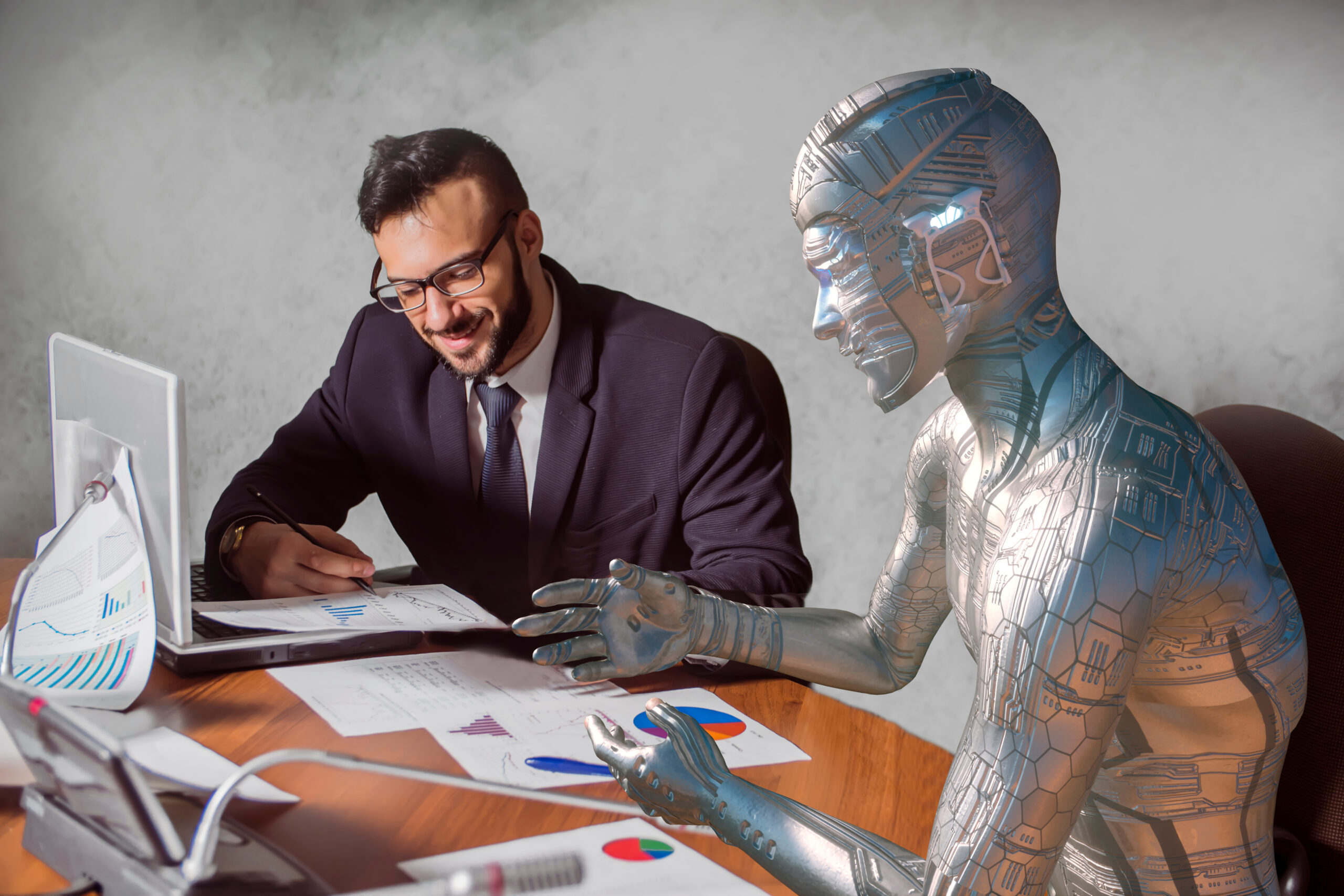
David Buchanan and Steve Macaulay explore how AI could reshape leadership, from augmenting decision-making to taking over selected management tasks. They examine the benefits, risks and human implications of bot bosses, and argue that L&D must prepare employees to challenge, collaborate with and, when necessary, override artificial leaders at work.
Could artificially intelligent (AI) bots take over leadership roles? What are the implications for human resource management, and for learning and development? AI can display cognitive abilities that allow it to automate the knowledge work of a range of professional occupations. Why not ‘boss work’?
What benefits could AI bots as leaders bring? Before you dismiss this idea as futuristic fantasy, be aware that this future is already here.
AI for work at scale
For example, a city council has digitally cloned one of its employees, Geraldine. She was a therapist in social care, and a valued source of advice for colleagues. But a growing number of requests for help prevented Geraldine from doing her own work.
The council developed an AI chatbot called ‘Hey Geraldine’ using her tone of voice, knowledge, and professional insights. Staff now get instant, tailored advice from the chatbot, as they would have done from Geraldine herself.
Your organisation could produce a digital clone of your chief executive, maybe called ‘Hey Boss’.
Can bots do boss work?
It is easy to dismiss the idea that AI can do boss work. Sure, AI can draft your emails, create agendas, schedule meetings, take the minutes, and support decision-making. But how about building trust, setting aspirational goals, making difficult judgements, creating new ideas? These are still things that only we humans can do. Aren’t they?
According to one research study, based on interviews with AI experts, AI bosses are never going to happen. Interpreting ambiguous information, formulating a vision, assessing the human consequences of decisions, and exercising judgement need human input.
However, some leadership tasks can be augmented by AI, including complex decision making, analysing and interpreting data, generating fresh perspectives, business forecasting, job candidate screening, prioritising tasks, and risk assessment.
Several leadership tasks are in this ‘augmented’ category. This suggests that AI is going to have at least some impact on your boss’ work.
Being fully functional
AI systems can mimic human intelligence, learn from experience, and display many leadership behaviours. These include setting targets, monitoring performance, giving feedback, delivering a motivational speech, generating and assessing options for solving problems, and taking decisions.
Think of the advantages of having an AI bot for a boss, someone with no ego, no grudges
Today’s leaders already benefit from AI assistance, so it’s not a major leap for AI to take over some leadership tasks completely. Think of the advantages of having an AI bot for a boss, someone with no ego, no grudges, no insecurities, no hang-ups, no prejudices, no favouritism, and no bad temper.
Your AI bot boss could be computer-based, like HAL from the movie 2001: A Space Odyssey. Or it could have a physical presence such as Data from the TV series Star Trek: The Next Generation, or C-3PO from the Star Wars movies.
Other superpowers
As well as boss work, an AI bot can process and draw from vast amounts of information, take part in team meetings, write the minutes, and store records. It can also learn from member interactions about preferences of individuals and use that information to manage future interactions.
Your bot boss can collect data from other AI devices along with information from LinkedIn, Instagram, Facebook, and Snapchat, for example, and summarise for you the profiles of people you want to know more about (job applicants, competitors, colleagues). Feedback, coaching and training can be tailored to the needs and interests of individual staff.
There are of course downsides. Your AI bot has no passion or emotional intelligence and will not handle human relations well. Ethical and legal issues will arise if an ill-judged AI decision has damaging consequences. Who will be accountable if that happens?
Welcome to the future
AI bosses are more likely to be found in middle and front-line management roles, but perhaps not at chief executive level, where decisions are both more nuanced, and more critical.
We may see the emergence of new forms of shared leadership, with complementary strengths. A silicon-based AI bot handles clear-cut issues, and its carbon-based counterpart deals with the complex and sensitive issues that call for judgement, empathy, and intuition.
This is not a wholly futuristic fantasy. Some of this future is already in place. For example, research by an American software company found that:
- 74% of chief executives have greater confidence in business advice from AI than from friends and colleagues
- 64% have integrated generative AI into their decision making
- 44% believe that AI insights are better than their own
- 38% trust AI to make business decisions for them
One executive in this study explained: “AI is as capable as the smartest people on the planet of parsing data and coming up with the key options. Executives trust the input of a friend and a colleague, but the friend and colleague didn’t just parse 2 billion pieces of information available to them.”
AI leadership training and subordinate development
AI companies have a lot of experience in training their AI systems. What they need is lots, and lots of data. The literature on leadership is vast, and a human being will take a long time to absorb it. An AI system can digest this at warp speed. Feed it case studies, and it will learn best and worst practice in different settings.
The main training and development need lies with the AI leader’s subordinates. How do you work with an AI robot boss? This is something that we may all have to learn.
Let’s start with the science fiction writer Isaac Asimov’s three laws of robotics:
- A robot may not injure a human being or, through inaction, allow a human being to come to harm
- A robot must obey the orders given it by human beings, except where such orders would conflict with the First Law
- A robot must protect its own existence as long as such protection does not conflict with the First or Second Law
Here are our three laws for working with an AI bot boss:
- A subordinate must challenge a bot boss’ decision if it is likely to harm humans, the bot boss itself, or the organisation
- If a bot boss gives an order that a subordinate believes to be wrong, they must ask for an explanation before deciding whether or not to comply
- Humans must protect their own interests, and that of the organisation, even if that means ignoring decisions made by the bot boss, and taking control themselves
Training for all: the HR and L&D implications
As AI bot bosses start to take over even parts of the leadership role, we will all need to develop new skills in how to cope. Different AI bosses may have different ‘personalities’ depending on their training. This means that they may behave in unexpected ways in some situations, such as crises. If your bot boss is confronted with an unfamiliar problem, its responses may be erratic (AI systems are prone to ‘hallucinations’), and human intervention may be required.
Knowing when to challenge your AI boss, and how to do that, will be a key skill. As will understanding the limitations of AI, and the ability to recognise system flaws and how to deal with them. L&D need to start planning to equip staff with the skills to work with AI bot bosses, as well as to work with AI systems in general.
Finally, your AI bot boss must come with a ‘kill switch’. Another key part of our training in dealing with these machines should be to learn when and how to use that switch.
Steve Macaulay is an Associate at Cranfield Executive Development. He can be contacted at: s.macaulay@cranfield.ac.uk
David Buchanan is Emeritus Professor of Organisational Behaviour at Cranfield University School of Management. He can be contacted at: david.buchanan@cranfield.ac.uk
