

Gargi Bhatt explores why disciplined questioning is making a comeback as work gets more complex and AI makes quick answers effortless. Drawing on Socratic dialogues, coaching and action learning, she shows how inquiry strengthens critical thinking, surfaces assumptions and builds reflective capacity, helping navigate uncertainty with clarity, curiosity and courage.
In a world obsessed with having the answers quick, clear, and confident, there is something quietly revolutionary about not knowing. As organisations grapple with rapid change, complexity, and the uncomfortable unknowns of modern work, the simple act of questioning is staging a comeback.
The Socratic method is proving to be an invaluable tool for those who want to think deeper, lead smarter, and learn braver
This is where Socratic dialogues come in. Born on the dusty streets of ancient Athens, this age-old method of inquiry isn’t just for toga-clad philosophers: it’s a secret weapon for modern minds. From psychology and coaching to leadership and learning, the Socratic method is proving to be an invaluable tool for those who want to think deeper, lead smarter, and learn braver.
Drowning in answers, starving for questions
Search engines, social media feeds, and AI tools like ChatGPT can supply information in seconds. But this flood of knowledge comes with a cost: we are slowly losing the ability to question. Recent studies indicate that critical thinking, an invaluable skill, risks being drowned out by the convenience of ready-made responses. The paradox is striking: access to information has never been easier, yet our interrogation of it has never been weaker.
Without the discipline of questioning, we accept surface-level truths and overlook biases. This is where Socratic dialogues resurface with urgency. They offer more than a historical relic; a timeless framework for slowing down, interrogating assumptions, and reawakening critical thinking.
Philosophy in conversation
The Socratic dialogues, written chiefly by Plato, are philosophical conversations in dramatic form, featuring Socrates engaging fellow Athenians on justice, virtue, knowledge, and love. Rather than formal arguments, they are vivid explorations of complex ideas where Socrates often adopts a posture of humility and ignorance, using Socratic irony to gently expose contradictions in the interlocutor’s thinking and reveal deeper truths through dialogue.
What makes the dialogues timeless is their commitment to open-ended inquiry. They rarely offer neat conclusions; instead, they model a way of thinking that is curious, probing, and profoundly human. From these exchanges emerged the Socratic Method, a disciplined approach to questioning that fuels reflection and critical thinking. Though the dialogues were literary and philosophical, this method has since been refined into practical tools for education, psychology, and L&D.
The Socratic Method in modern psychology
The Socratic Method has found a natural home in modern psychology, particularly in Cognitive Behavioural Therapy (CBT), where it’s used to challenge limiting beliefs and cultivate new perspectives. Instead of prescribing solutions, therapists ask structured questions that help individuals uncover assumptions and reframe unhelpful thoughts. This process engages metacognition (the ability to examine one’s own thinking), shown in research to improve self-regulation and resilience.
Neuroscience adds another layer. Studies using Socratic-style questioning to challenge negative self-beliefs have shown increased activity in the brain’s prefrontal and midline regions, areas linked to reflection and cognitive restructuring. Over time, this practice fosters neuroplasticity, allowing people to replace rigid mindsets with more adaptive ways of thinking.
This begs the question: can the wisdom of ancient Athens find new life in today’s boardrooms, training rooms, and coaching spaces?
Coaching, action learning, and the future of thinking
The Socratic Method shows up powerfully in coaching and action learning sets (ALS), where inquiry and introspection are put at the centre of growth.
- In coaching, the coach should act as a thinking partner, guiding reflection through incisive questions that surface biases, clarify values, and expand perspective. Research in developmental coaching shows that this strengthens critical thinking by activating metacognition. The non-judgmental environment mirrors the Socratic spirit: autonomy and exploration over advice and prescription
- In action learning sets, small groups work on live organisational challenges not just by giving each other solutions, but by asking probing, open-ended questions. This discipline of inquiry transforms a problem from something to be “fixed” into an opportunity to learn. Studies examining ALS show participants highlighted improvements in decision-making, reflective capacity, and the ability to think more clearly in complex leadership contexts, all outcomes that map directly onto critical thinking competencies
By repeatedly practising disciplined questioning, participants disrupt automatic thinking patterns, much like cognitive-behavioural interventions, and build a culture where curiosity and reflection become second nature. What makes this so powerful is the boomerang effect; the questioning challenges not just the learner but the facilitator, too. Everyone leaves a little sharper and curious.
The questioning cycle: Curiosity in motion
Think of the Socratic Method less as a formula and more a game of intellectual ping-pong: one question bouncing to the next, each revealing new angles and assumptions. The cycle moves through curiosity, probing, testing, exploring, and synthesising; looping back with each turn, deepening understanding.
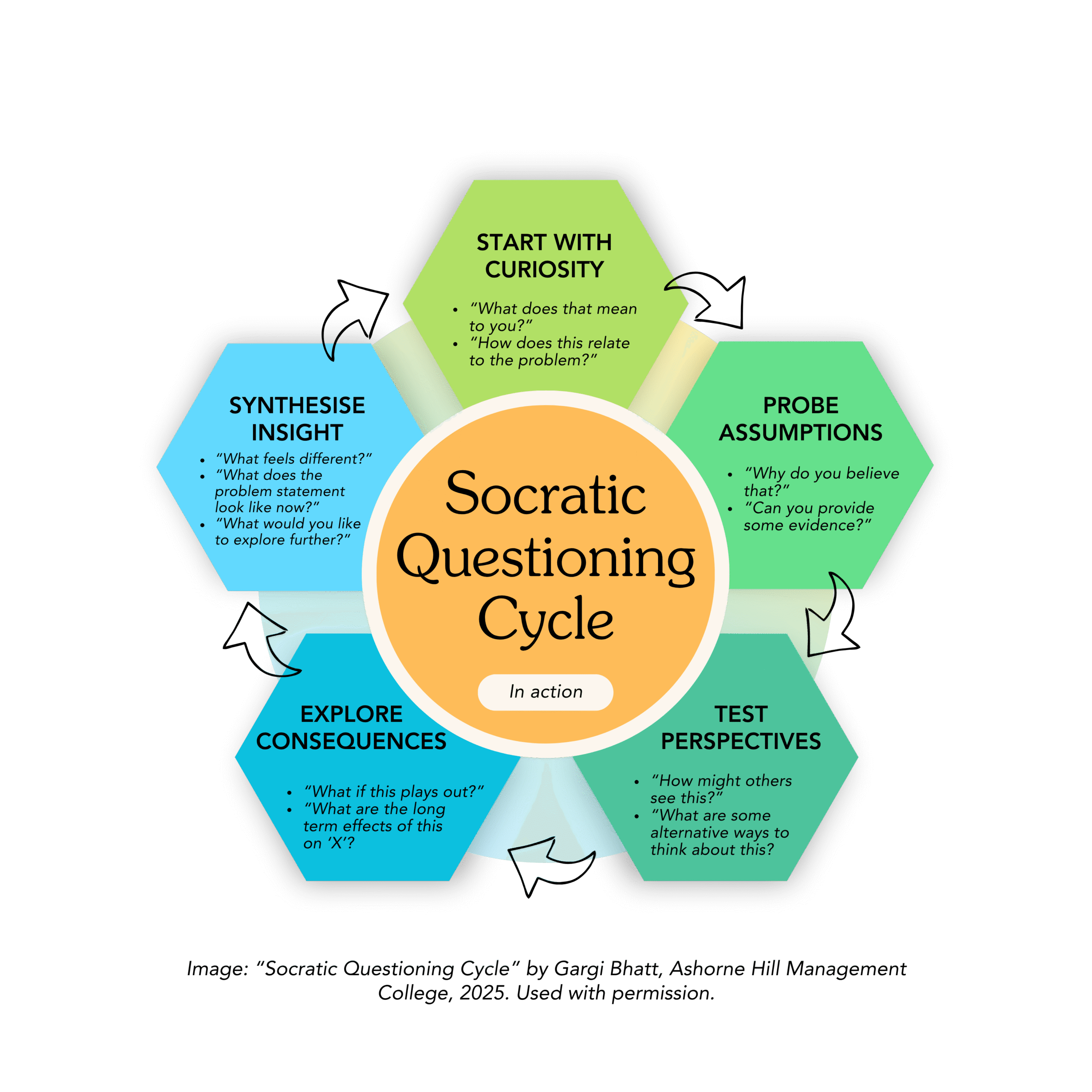
When leaders, coaches, and facilitators lean into this rhythm, they shift from “answer machines” to catalysts for discovery. Conversations become more alive, creative, and trusting. That’s why this ancient technique feels so future proof: it teaches us not just how to think, but how to continue thinking.
A call to question
Overloaded with data and racing against the clock, it’s all too easy to grab for quick fixes instead of asking better questions. But real growth begins not with answers but with inquiry. The legacy of Socratic dialogues reminds us that curiosity is our most powerful development tool. Whether in therapy, coaching, classrooms, or boardrooms, asking the right question reframes problems and ignites transformation.
For leaders, facilitators, and learning professionals, the invitation is clear: create spaces where inquiry thrives. Embrace the discomfort of uncertainty and rediscover the profound learning that begins when we dare to ask, “Why?”
Gargi Bhatt was L&D Business Analyst at Ashorne Hill Management College and is now OD Officer and Nottinghamshire Fire and Rescue Service
Reference List
Agathos, J., Steward, T., Davey, C. G., Felmingham, K. L., Ince, S., Moffat, B. A., … & Harrison, B. J. (2023). Differential engagement of the posterior cingulate cortex during cognitive restructuring of negative self-and social beliefs. Social cognitive and affective neuroscience, 18(1), nsad024.
American Association of Colleges and Universities. (2023). The Career-Ready Graduate: What Employers Say About the Difference College Makes. AAC&U. https://www.aacu.org/research/the-career-ready-graduate-what-employers-say-about-the-difference-college-makes
Chow, A. R. (2025). ChatGPT may be eroding critical thinking skills, according to a new MIT study. TIME. https://time.com/7295195/ai-chatgpt-google-learning-school/
de Haan, E., Grant, A. M., Burger, Y., & Eriksson, P. O. (2016). A large-scale study of executive and workplace coaching: The relative contributions of relationship, personality match, and self-efficacy. Consulting Psychology Journal: Practice and Research, 68(3), 189.
Department for Digital, Culture, Media and Sport. (2021) Quantifying the UK Data Skills Gap – Full report. GOV.UK. https://www.gov.uk/government/publications/quantifying-the-uk-data-skills-gap/quantifying-the-uk-data-skills-gap-full-report?#introduction
Steward, T., Kung, P. H., Davey, C. G., Moffat, B. A., Glarin, R. K., Jamieson, A. J., … & Harrison, B. J. (2022). A thalamo-centric neural signature for restructuring negative self-beliefs. Molecular psychiatry, 27(3), 1611-1617.
Vittorio, L. N., Murphy, S. T., Braun, J. D., & Strunk, D. R. (2022). Using Socratic questioning to promote cognitive change and achieve depressive symptom reduction: evidence of cognitive change as a mediator. Behaviour research and therapy, 150, 104035.
Walia, S., & Marks-Maran, D. (2014). Leadership development through action learning sets: An evaluation study. Nurse education in practice, 14(6), 612-619.
Paul, R., & Elder, L. (2019). The thinker’s guide to Socratic questioning. Bloomsbury Publishing PLC.
