
External training providers face cultural barriers, politics and self-doubt when pushing for real impact. This conversation uncovers how to secure supervisor buy in, differentiate your offer, harness digital nudges, and use AI as a practice partner so that learning translates into behaviour change and business value inside modern organisations today.
This discussion explores how external training providers move from delivering isolated events to shaping real organisational impact. It tackles the fear of challenging clients, the politics around “admitting we missed this before”, and the importance of clarity on value. Practical ideas include manager engagement nudges and using AI as a live practice partner to build confidence, embed skills and scale support.
Key takeaways:
- You cannot deliver impact alone: secure supervisor and stakeholder involvement from the outset, not as an afterthought
- Vendors often avoid tough conversations through fear of admitting “we should have done more” in the past. Honest re-positioning builds credibility
- Differentiate clearly: state the problem you solve, why it matters, and how your approach delivers more value than competitors
- Simple tools work: for example, prompts for learners to brief their managers on what they learned and what support they need
- Understanding client motivation and organisational outcomes elevates you from deliverer of events to strategic partner
- Experimentation is essential: test, fail, learn and iterate rather than waiting for a perfect model
- AI and large language models can act as a digital colleague, coach and role play partner to practise conversations, influencing and presentations in realistic, low risk ways
Guests
- Melanie Martinelli
- Paul Matthews
- Gori Yahaya
- Stella Collins
- Daniel Solomons
- Simab Raja-Ahmad
- Erica Farmer
Interviews and filming by Gaelle Watson of SyncSkills
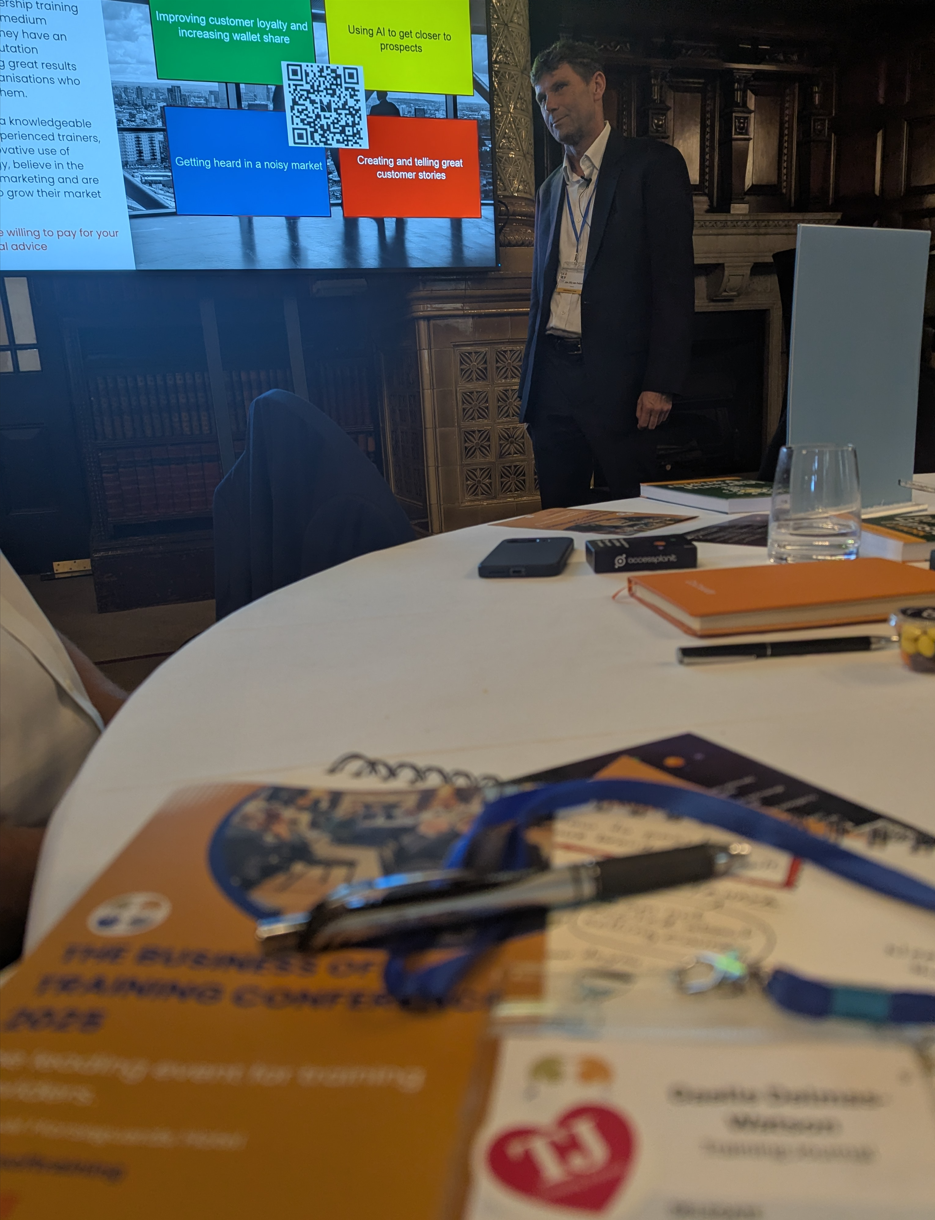
This all took place at the Business of Training Conference from Inmisceo
Transcript from TechSmith Audiate:
…Vendor, you very often feel that how do you influence that? Like, let’s say, supportive supervisor. How do I get access to those supervisors? Uh, even internal L and D might be struggling with that. So I think part of it is just kinda making sure that we get that, you know, that buy in right at the start, sensitizing our clients that we will have to collaborate with the business to make it happen because all alone, it’s just not gonna be possible.
And I think with that, the barrier is that maybe sometimes as a vendor, we are afraid to ask for that. In learning teams and organizations, I often think, well, if we start talking about it and then start asking the organisation to do stuff about it, kind of means we were wrong all those years. Yeah. So I don’t feel…confident in going forward and saying, I made a mistake. We weren’t doing enough about this.
We need to now do more about it. So I think there’s a whole lot of psychological factors at play there in the politics of an organization and in the culture. I think competition is brilliant. I think it challenges us to be able to provide something that’s a bit different to others. So it’s really key that you can really articulate what it is that you the problem that you solve, but the value that you provide that might be better than others, which is really, really key.
So for us, we’re very big consumer led learning. We love live facilitation. We find a way to make it affordable. We find a way to make it scalable, and we do across different countries. So, um, you should really when you are articulating your message, whether you’re using LinkedIn or any other platforms, uh, find a way to make sure that that kind of really range through, right, comes through as your as your as your value driver. So I think it’s really important as external training providers in particular to think about how you can influence the client to do the work. You probably can’t be there yourself, but how can you do that? Um, how can you use digital technology? Give every learner…a note to take back to their manager that says, dear manager, this is what I’ve learned, and this is the help I need. Can you support me? Very simple, but very effective. I came here with a very open mind, and I’m glad I did because I wasn’t exactly sure what to know what to get from being here. I wanted to connect with like minded people. I wanted to get some tips.
I want to build my business because I’ve just lost a big client. I need to build new clients up. But most importantly, I wanted to connect with other professionals in a similar space at this time. There’s some big takeaways, and I think the biggest phrases that are in my mind at the moment are to understand the motivation of my customers, not just the symptom, and really get under the skin of them. A lot of the work I do, yeah, we get to… measure and make an impact on a lower level. But if we can understand how that happens at an organizational level, that’s gonna make me much more valuable to my customers. We’ve done so much unpacking of what it actually means to deliver value to our to our customers, to our clients, um, and even to our own business internally as well. Um, but really realizing that is gonna be a big challenge for us because I think there’s been a lot of information actually that we’ve been able to extract from all of the really vibrant discussions. Um, but my biggest takeaway is probably the fact that it’s okay to go away, experiment, fail, try again, find your way forward, manifest where you wanna be and where you think that journey is gonna take you.
Using it as another trainer, facilitator, ability for delegates to role play with it, practice new skills. If you’re having that difficult conversation, if you need to practice influencing or pitching or presenting or whatever it might be, you can do that with an LLM. And I’m not just talking about typing into it. You can speak into it on your phone, on a mic, whatever it might be. Um, and we can use all of this as opportunities for a thinking as another digital colleague, a trainer, a coach, an actor to really embed those skills going forward.
