
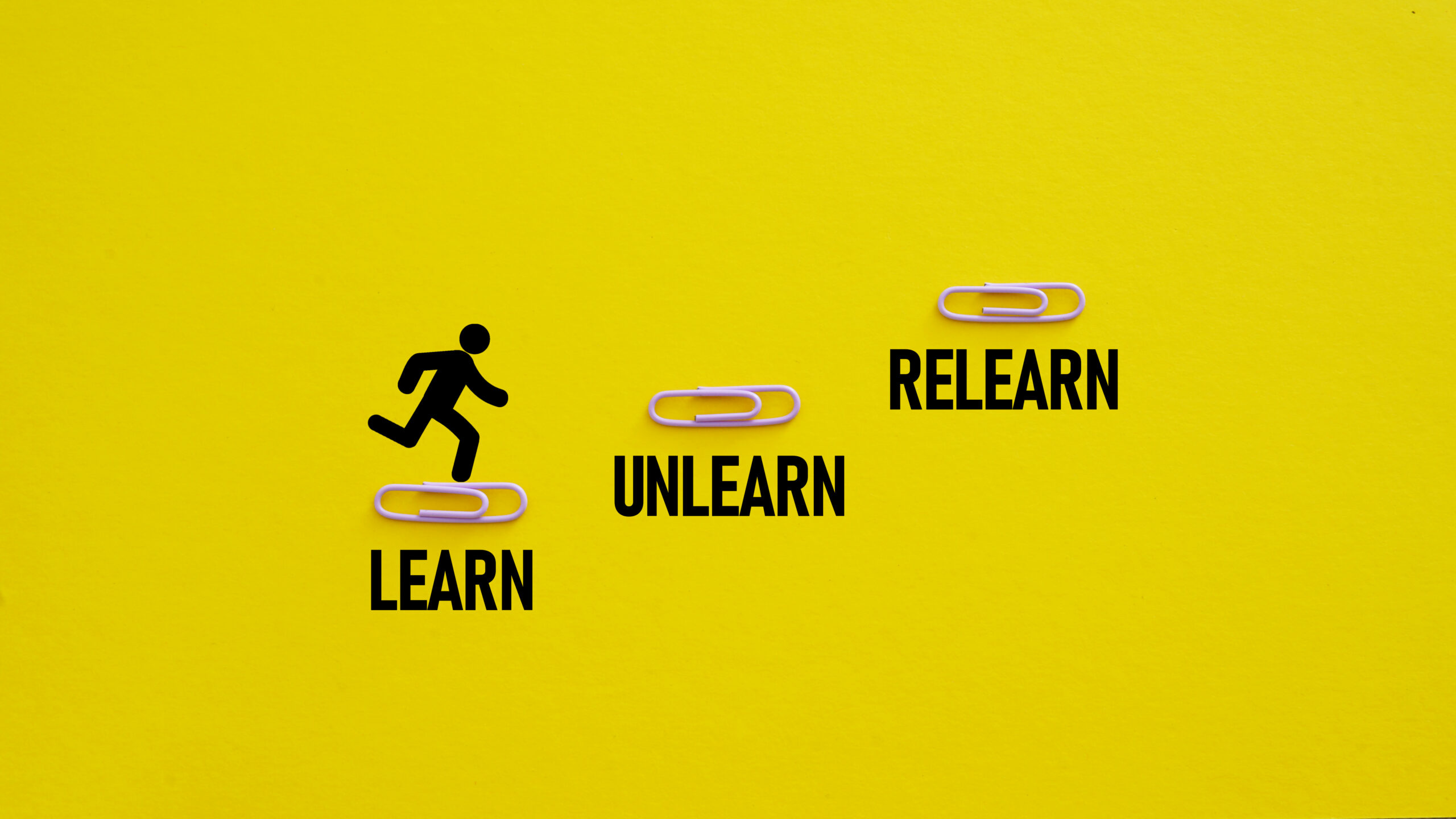
Chief Learning Officers are being asked to reinvent organisations, while AI rewires jobs and careers. The route is unlearning: letting go of ladders, fixed roles and ‘training as an event’. Dr Helmut Schuster and Dr David Oxley set out four imperatives for CLOs to build experimentation, trust, AI and capability.
We are entering an era in which organisational reinvention is not optional. It is constant and structural. Artificial intelligence (AI) is reshaping roles and workflows. Career ladders are collapsing into lattices. Talent now moves across boundaries rather than sitting neatly inside them. Against this backdrop, learning and development leaders face some significant problems and challenges.
“First you must unlearn what you have learned”
Yoda
This article explores the challenges CLOs and L&D teams are likely to navigate over the next decade and concludes that when we step back from the messiness of reinvention, we can draw three strategic imperatives.
Unlearning as a prerequisite for learning
The famous Yoda quote resonates today because unlearning has become a critical organisational competence. Many organisations are set in their ways. Married to conventional hierarchies, job ladders, job descriptions, and succession plans. Traditional models of career progression have relied on gaining experiential knowledge in bite-size progressions. The future seemingly upends or at the very least threatens to remove the carpet from under those legs.
We don’t have to look too far for evidence of this, from articles in Forbes, the hype of the Job-Apocalypse, or more thoughtful examinations like The Second Machine Age, and David Graeber’s pithy challenge. The problem is that many organisations are like super tankers: it’s hard to slow them down and to make big turns.
Bridging the experiential divide
Of course we are trying, but short-term fixes lead to longer term consequences. Career ladders have been replaced by project webs and fluid teams. Employees no longer rely on predictable pathways that allow gradual mastery. Instead, they must quickly gain proficiency in emerging tools and practices, often without established playbooks.
Successive ‘right-sizing,’ structural reorganisations and even COVID-era hybrid work practices create unintended consequences when it comes to evaluating the effectiveness of enterprise learning and succession. The trick is probably to leave the past behind, to make the bold but necessary step to stop lamenting a past era. Leave the Band-Aids and workarounds behind to take a necessary, and inevitable, step toward what’s next.
Championing AI adoption while avoiding cognitive traps
Here we have to turn back to AI. It seems like both the challenge of the momentand potentially a key to a new horizon. One of the major challenges at present is job defensiveness and preservation. At the individual level, many workers feel underprepared and underconfident. Recent news highlights that large segments of the UK workforce have had little or no formal training in AI and consequently do not feel capable of using it effectively.
This gap is not simply a technical one. It is a psychological and cultural readiness gap. Research increasingly shows that sustainable AI adoption depends on cycles of experimentation, reflection and integration rather than one-off technical deployment.
Developing human capabilities for an AI enabled future
As AI automates select tasks, the skills that differentiate human workers shift toward qualities such as empathy, ethical judgment, creative problem solving, collaboration across diverse domains and critical thinking. Research on computational thinking and lifelong learning underscores that these human-centred capabilities will become increasingly vital.
These capabilities are resource intensive to develop and measure. Yet L&D teams are being asked to nurture them while operating with leaner budgets.
Embedding ethics, purpose and trust into AI Systems
AI is powerful but it is not neutral. Without intentional design, it can amplify bias, erode trust or misalign with workforce values. Studies of employee well-being caution that poorly implemented AI can undermine transparency and psychological safety.
Ensuring that AI strengthens rather than weakens organisational culture is a leadership and learning challenge, not just a technical one.
So where do you start?
Taken individually, these challenges seem daunting and even abstract. However, if we step back from the mosaic, we think patterns do emerge.
These four themes stand out:
1. Reduce defensiveness and build psychological safety for change
We think AI is like the emergent digital tools of the early 1990s. More powerful, by most people’s opinions, but in terms of how people relate to them, similar. This adoption challenge is an essential first challenge. Not only is it an institutional necessity, first adopters are advantaged professionally. They become advocates and beneficiaries of being seen as pioneers.
Connected to this is the blocking and defensive behaviour of the Luddites: the resistant, work-to-rule audience who seek to curve themselves out from any change. There are obvious costs to this and dismantling it early is a brilliant place to start. In this context, L&D must become advocates, champions, and first movers themselves. Engaging with AI, deploying AI tools, developing sandpits and virtual playgrounds. Demystifying AI is largely about just using it. It’s extraordinary but also, once you realise how silly it can be, well, all of a sudden, it’s not so scary.
2. Champion AI positively rather than restrictively
Organisations often default to regulating AI first and enabling it second. This inadvertently signals mistrust. Instead, L&D should promote a constructive and opportunity focused approach.
This includes:
- Enabling on-the-job practical use
- Highlighting early success stories within teams
- Building a narrative of empowerment rather than surveillance
- Encouraging small experiments that may fail yet yield insight
People must break eggs to make omelettes. They need space to experiment and occasionally misstep. Without that permission, learning stalls, adoption slows, and innovation becomes uneven.
In many ways, this is also the recipe for the L&D. How can they engage with AI tools to deploy learning opportunities to everyone, in real time, with personalised outcomes. It’s not hard to imagine how L&D transforms itself into more of a ‘helpdesk’ or even ‘online, on-demand’ coach and co-pilot. Imagine what the world would be like if you spent each day actively engaged in helping people solve problems, learn in real time, and get instant feedback on your efforts.
3. Using AI to foster a new talent development model
The great liberating power of AI is the ability to construct order from chaos. To create a means to foster a collaborative and dynamic environment free from jobs descriptions and hierarchical constraints. It becomes possible to imagine the truly boundaryless organisations where the CEO could collaborate on a project in real time with a new hire graduate. That teams could organically form, perform, and disperse each week.
In this amorphous, dynamic environment, you could help curate learning, development, and broadening of professional experience. This feels like a great time to lean into this way of thinking.
4. Build AI systems that reflect organisational values
This final imperative is the most strategic. AI tools must be consciously aligned with the purpose, cultural norms and ethical principles. Failure to do so leaves adoption to chance, and chance does not produce fairness or meritocracy.
L&D is uniquely positioned to partner with AI teams to steward:
- Ethical decision-making frameworks
- Values-based design principles
- Training on responsible use
- Governance that empowers rather than restricts
By shaping, but not controlling or limiting, the learning environment around AI, L&D ensures the technology strengthens the culture rather than distorting it.
Why HR and L&D must lead
These challenges are fundamentally human. They require trust-building, behavioural change, ethical clarity and continuous capability development. Technology teams cannot drive these shifts alone. HR and L&D must lead because they are the stewards of culture, capability and organisational identity. The work ahead is less about teaching skills and more about enabling reinvention. L&D
CLOs and L&D professionals stand at a defining moment. What got us here won’t get us where we need to go. We see four new ways to frame the future:
- Unlearn the idea that learning is episodic or role bound
- Build learning ecosystems that foster experimentation, trust and sense-making
- Reframe L&D as role models, real time virtual coaches and mentors
- Shape AI adoption in ways that reflect organizational values and human potential.
Lifelong learning looks different going forward. It’s less aspirational, less a mantra, less an affirmation and more an action and shared activity. Or at least, that now seems possible. And why wouldn’t we want to run towards that? It seems exciting. We have an opportunity to shape a future that is fairer, more human and more capable.
Let us end again with Yoda: “Do. Or do not… Train yourself to let go of everything you fear to lose.”
Dr Helmut Schuster and Dr David Oxley are Co-Founders of Drs Schuster & Oxley and co-authors of Artificial Death of a Career: How to stay relevant and thrive in the age of AI
