
In time defined by AI, uncertainty and shifting norms, Phil Reddall argues L&D must stop reacting and start navigating. Using the Global Sentiment Survey and a Learning Operations mindset, he shows how data, business alignment and clear pillars help teams measure maturity, break silos and stay useful, today and beyond.
“It’s time to draw our own map.” Don Taylor’s line from the Global Sentiment Survey (GSS 2026) has stayed with me because it captures something important about the moment we’re in. The need to be more proactive and less reactive has always been there, but in 2026 it feels sharper. We each need a plan. It doesn’t have to be complex, but it does need to be flexible, and it does need to exist.
I’ve been thinking a lot about the challenges facing our industry and our profession. I keep coming back to a simple phrase: the same but different. We’ve always needed to show impact and align to business goals, but something in the environment has shifted. The fundamentals still matter; they just need to be applied differently.
The context we’re working in
Don captures this shift well in the GSS: “This is the most significant set of results in the thirteen years of the L&D Global Sentiment Survey. Not because they describe a specific change, but because they do not. They point to a breaking down of old norms, and it is not clear what will replace them…”
He goes on to describe the combined pressure of AI, economic uncertainty, war and unrest. I’ve started referring to this as a polycrisis. It’s not the most uplifting term, but it does reflect the reality. And with uncertainty comes opportunity, if we’re willing to rethink how we work.
What the GSS tells us
The GSS highlights five challenges the profession believes it faces:
- AI adoption and integration
- Demonstrating value and impact
- Budget and resource constraints
- Learning engagement and application
- Change, uncertainty and L&D’s new role
But we shouldn’t treat these as a sequence to work through. AI may be critical for some organisations right now, but not for others. And it certainly won’t solve everything. The place to start is understanding your current state.
Why Learning Operations matters
When we look at strategy and tactics for learning, talent and capability, the first step is the engine room: Learning Operations. It’s the equivalent of needs analysis, but at a functional and business level. Where are we now? Where are we going? What’s the gap?
This is also where we need to avoid parochial thinking. I’ve led large HR teams and I’m a huge advocate for sharing best practice across Centres of Expertise. But I’ve also seen how easy it is to slip into siloed thinking. The current business context demands a more connected HR strategy; one that recognises the interdependencies across Talent, Reward, Recruitment, HR Partnering and L&D.
Measuring progress over time
There are plenty of maturity models in our profession. They’re useful, and you can choose the one that fits your context.
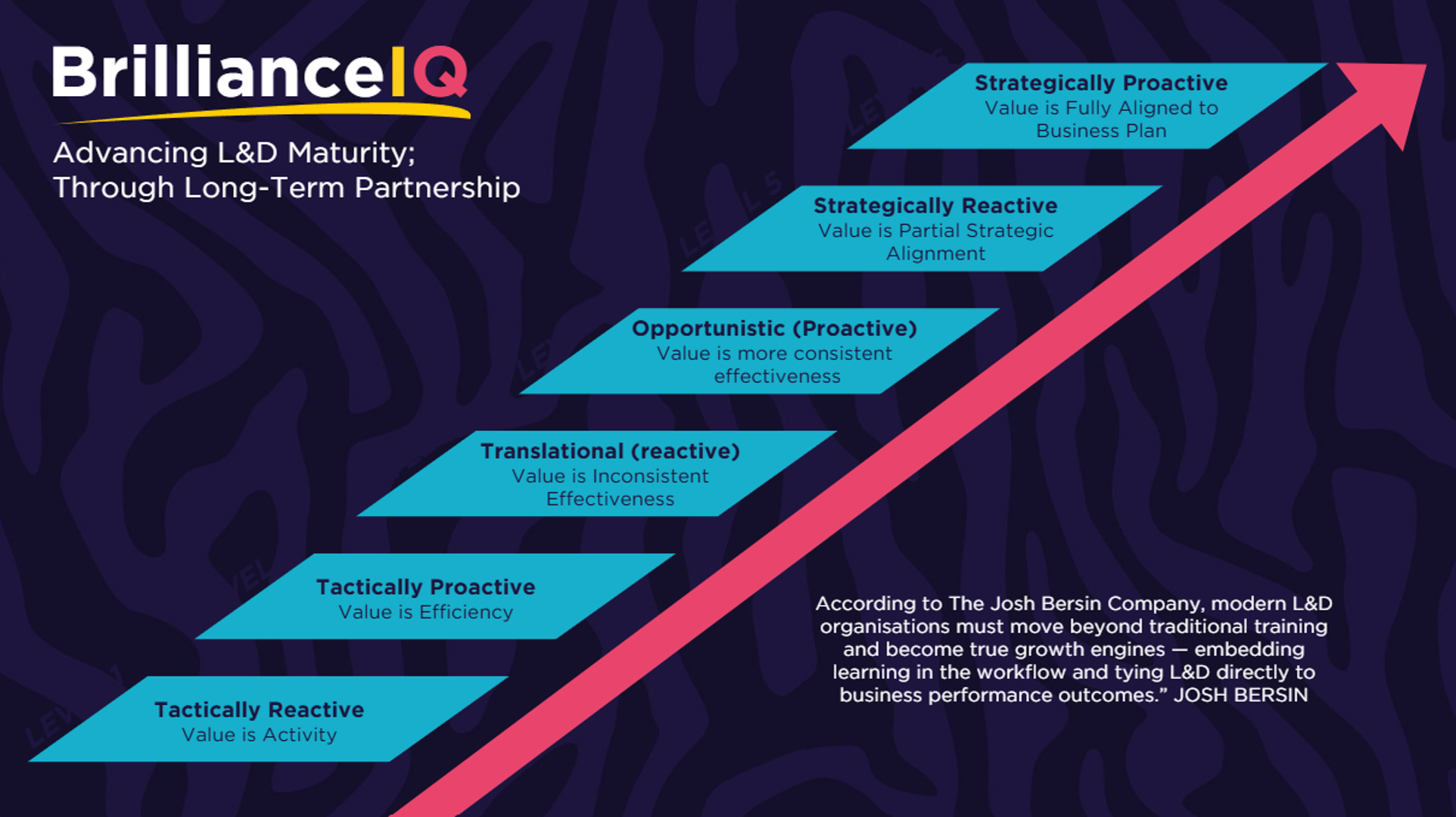
I’ve built one based on two dimensions, Proactivity and Value. This gives a simple, honest starting point. The important thing is to benchmark yourself early so you can track progress over time.
A helpful framework
A Learning Operations improvement mindset helps L&D stay relevant and break down where improvement is needed, even when the environment around us is volatile.
The Brandon Hall Group recently outlined Learning Operations in five pillars:
- Consolidation of Tools
- Strategic Alignment
- Operational Excellence
- Data-Driven Decision Making
- Skill Development
Whether you use those exact pillars or not, the reminder is useful: the core operation of L&D needs attention. I believe that there’s a hierarchy to the focus on these areas and that we should start with Strategic Alignment, Operational excellence and Data driven decision making. That’s where we get clearer on metrics, activity, governance, structure and the things that help us respond to the challenges we’re facing. Only then move on to the tactics that might include platform consolidation or skills development.
Principles for the future
At a recent session, Eoghan Thompson from KPMG asked what the future principles of the learning function might be in a context of change, innovation and disruption. I landed on four:
- Be closer to the business and the line, metaphorically and physically, to stay aligned and agile
- Shift more towards enablement and coaching
- Lead communities of practice as much as we create content
- Work more closely with all HR centres of excellence, because workforce challenges won’t be solved by one function alone
These principles matter, but they only work if two priorities are already in place.
Two priorities to get right
First, you need a clear handle on your own data; what you’re doing, where your time and money goes, and what that tells you. Without that, it’s hard to make informed choices.
Second, you need to be close to the commercial reality of your organisation. Understanding what the business is trying to achieve is essential if you want your strategy and tactics to land.
With a Learning Operations mindset, clarity in the two priorities and a focus on the core pillars of your function, you can start drawing your own map and navigate whatever comes next.
Phil Reddall is Principal at The Capability Advisory and Co-Founder of BrillianceIQ
