
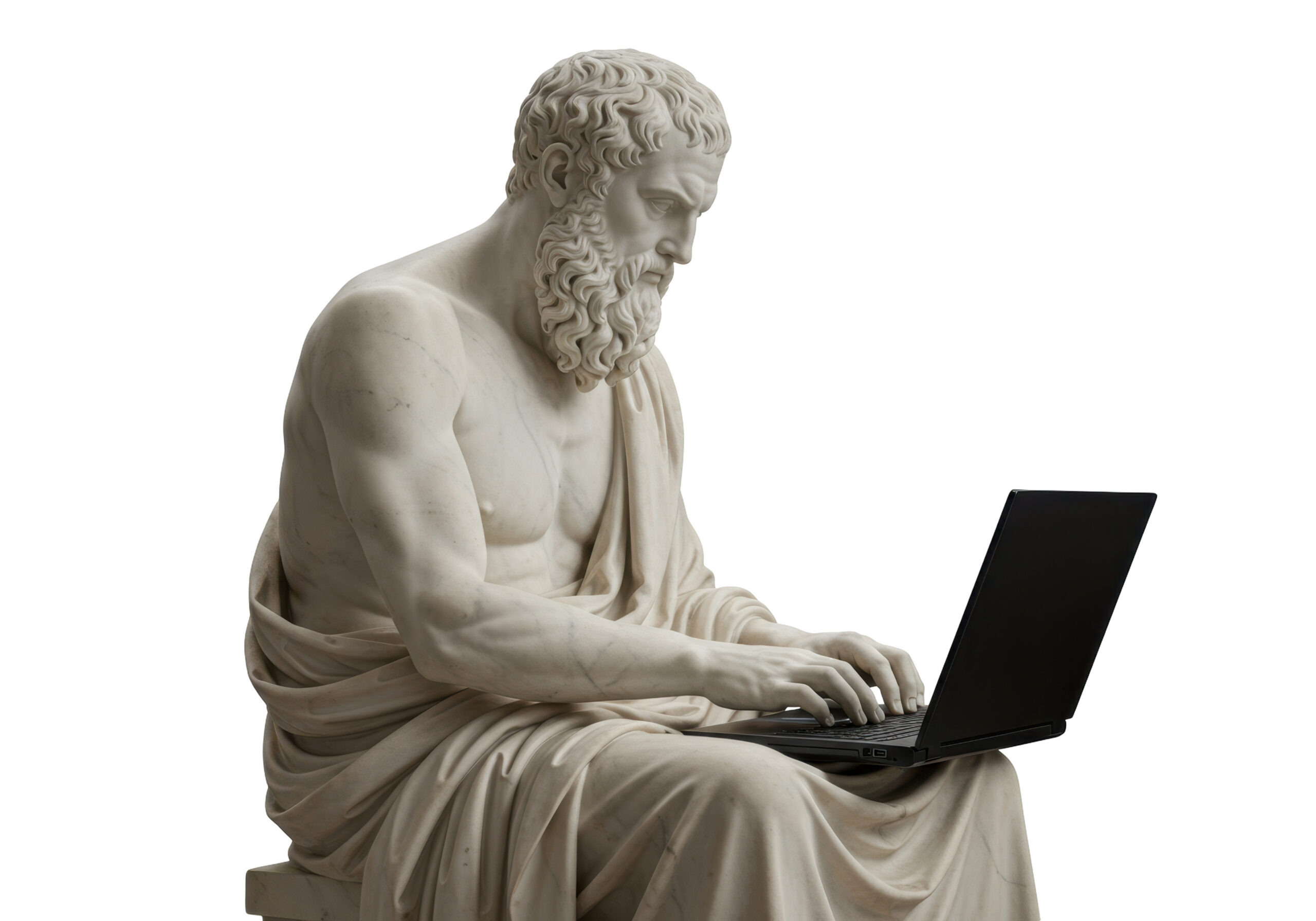
With employee engagement falling and global uncertainty rising, Nabil Verdickt argues that people need more than perks, wellbeing apps and purpose slogans. Drawing on Stoic and Aristotelian thinking, Nabil explores how leaders can restore meaning by helping people see their contribution value, practise excellence and build genuine connection at work.
Employee engagement is quietly breaking down, and it is no surprise. Despite endless initiatives, digital wellbeing apps, and purpose statements painted on office walls, global engagement remains stubbornly low. Gallup’s 2025 data shows only 21% of employees worldwide are engaged at work. Redundancies are rising and job security is fragile; employees feel less connected to their organisation’s future than at any point in the past decade.
Employees no longer ask, “What do I do?” but “Why does it matter?”
As hybrid work becomes permanent and AI reshapes roles, employees no longer ask, “What do I do?” but “Why does it matter?”. The uncomfortable truth is that most organisations, led by efficiency-focused HR teams, have no real answer, unfortunately.
Meaning always lies outside the thing itself
In this quest for the search for the meaning of work, we might follow the modern French philosopher Julia de Funès, who reminds us that “To rediscover meaning, we must rediscover the sense of words.”
In French, sens carries three intertwined meanings: signification (what something means), direction (where it leads), and sensation (how it feels). Its Latin root, sensus, means perception or judgement. Together they reveal a simple but profound truth: meaning is never contained within an action itself. It exists outside; in how that action connects to others, to purpose, and to the shared reality we help create.
Yet modern organisations focus obsessively on one dimension, sensation. They try to make work feel better by redesigning offices, hiring “Chief LOL Officers,” installing meditation rooms, offering yoga subscriptions, or creating happiness dashboards. All fine, but sensation pursued without significance or direction produces surface-level satisfaction with a hollow core. Employees may feel good briefly yet still wonder why any of this matters!
Meanwhile, companies often emphasise direction such as strategy, growth, and career progression without addressing what that direction truly means for people. The inevitable outcome is the same emptiness but only better dressed.
Now, the task for modern leaders and HR professionals is, therefore, not to make work more entertaining or more efficient, but to help people reconnect the sense of what they do with what it serves. In today’s environment of restructuring and AI-driven change, connection to the whole is what preserves both engagement and resilience.
The Stoic path: Meaning through contribution to the whole
For the Stoics, meaning was never a fleeting feeling but a way of perceiving one’s place in the world. The Greek concept oikeiôsis describes a developmental process: individuals begin by recognising their own needs and self-preservation, then gradually expand concern outward to family, community, humanity, and ultimately the cosmos. Epictetus emphasised on the importance of seeing oneself as part of a broader moral and social order, moving from personal interest to group responsibility.
In the workplace, even routine tasks can take on this meaning when framed as service to a larger system. A payroll officer using SAP ensuring salaries are processed preserves trust across the organisation. A logistics coordinator working for a big corporation such as Google maintaining delivery accuracy keeps promises to customers. These applications are modern interpretations of Stoic insight: meaning emerges when employees understand how their work contributes beyond themselves.
Leaders and learning professionals can foster this perspective by helping employees trace the real impact of their work, through reflection, story-based exercises, or mapping. They can also reframe challenges, system changes, tight deadlines, or budget cuts, as opportunities to participate in sustaining the organisation and supporting colleagues. Meaning arises not from recognition or novelty but from seeing one’s actions as contributing to a shared whole, a central tenet of Stoic ethics.
The Aristotelian path: Meaning through practising excellence together
Aristotle taught that human flourishing “eudaimonia” arises through the cultivation of virtue, including moral virtues like courage, justice, and practical wisdom, alongside intellectual virtues. Virtue comes from using our reason well in the work we are meant to do. Modern jobs, however, often fail this test when roles are so fragmented making impossible to practise judgment or courage. As a result, work becomes a mere transaction rather than a path to developing character.
In the modern workplace, this could be translated into encouraging employees to develop capabilities that align with organisational and personal values. A software engineer helping a colleague solve a complex bug exercises practical wisdom. A manager distributing work based on everyone’s capabilities exercises equity. A project manager addressing ethical concerns that everyone sees but rather forgets to exercise courage. While collaboration can provide opportunities to practise virtue, meaning arises from the individual’s development of character and judgement in context, not merely from group activity.
Learning professionals can support this by creating reflection groups: prompting employees to consider how their actions demonstrate wisdom, courage, or fairness, and by recognising growth in both skill and judgement. Work becomes meaningful as a field for exercising and refining virtue within real-life challenges.
The myth of “finding your purpose”
In recent years, personal development culture and coaching have popularised the idea that work should always be a personal calling. Employees are urged to “find your purpose” or “align your passion with your job,” and this language has seeped into managerial lexicon. At first glance, this sounds inspiring.
Yet it carries heavy costs. It shifts responsibility for meaning entirely onto individuals, asking them to feel perpetually inspired, even when the system itself is uninspiring. It breeds what philosopher Byung-Chul Han calls the burnout society, where people are exhausted not by overwork but by the pressure to be endlessly passionate and self-motivated.
The damage is visible. Disillusionment occurs as workers who do not feel “called” believe they have failed personally. Exclusion happens as only creative or high-profile roles are valued as meaningful. Silencing emerges when questioning a company’s stated purpose becomes taboo. This ideology also lets organisations off the hook. If meaning is treated as a personal quest, leadership bears no responsibility to make work meaningful.
Ancient wisdom, however, offers frameworks for living meaningfully within the ordinary.
Towards meaningful leadership: Courage and enabling meaning in an age of automation
In this context, courage becomes the defining leadership virtue. As theologian Paul Tillich wrote, “The affirmation of one’s essential being in spite of desires and anxieties creates joy.” Brave leaders challenge bureaucracy, remove unnecessary processes, and question conventions that obscure meaning. They create space for employees to connect, contribute, and push themselves, enabling discovery of significance, direction, and sensation in work.
Leadership is not about comfort or wellbeing management, in fact It is about actively restoring human engagement by allowing people to see their work’s contribution, develop capabilities in collaboration, and experience authentic belonging. By enabling these conditions, leaders ensure that technology serves meaning, not the other way around, and that employees can flourish even amid uncertainty, redundancy, and automation.
The engagement crisis will not be solved by more perks or programs. No, it will be solved by leaders who have the courage to prioritise meaning, to remove obstacles, and to restore the conditions for genuine contribution, excellence, and interdependence. That is what ancient wisdom offers modern leadership: not nostalgia, but depth. Not slogans, but pure sens.
Nabil Verdickt is Head of Digital Marketing & Analytics at Penna
