
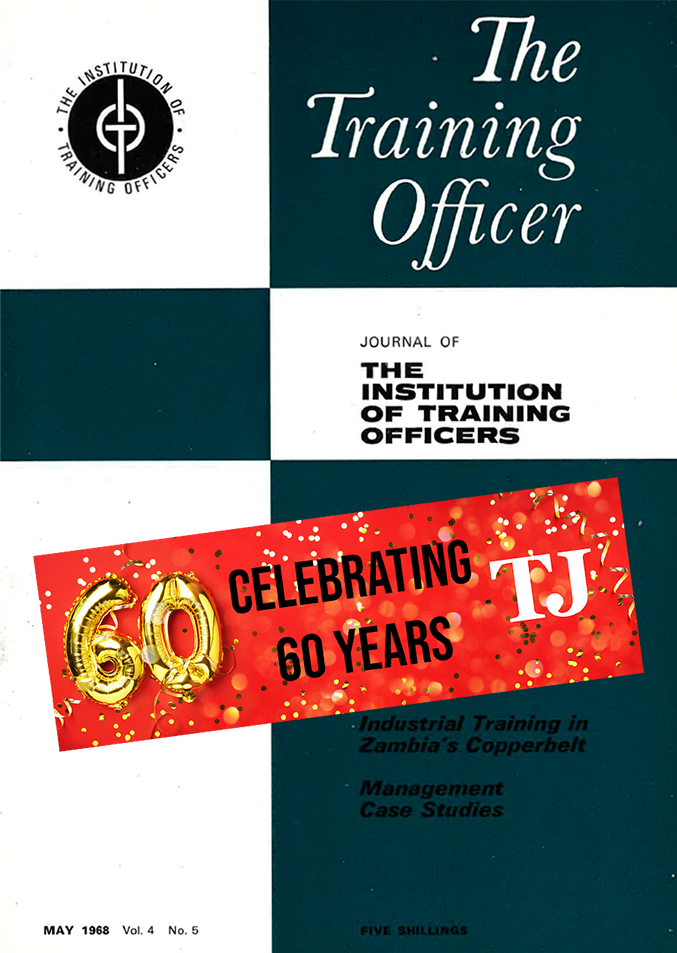
From critical path diagrams and formal standards to televised training and overseas schemes, The Training Officer in 1968 shows an L&D profession preoccupied with order, technology and status. Through today’s lens, its worries about credibility, media hype and meaningful impact feel familiar, and sometimes uncomfortably unfinished. Dive in and explore!
This time, rather than a full magazine, this is some selected articles from a few issues in 1968. What jumps out first is how professionalisation obsessed the 1968 issues are. The May edition trails “The Training of Training Officers” and carries long pieces on the new C.T.C. “Orange Book” and “the contribution of the Institution” to standards. The argument is essentially that training needs its own qualified specialists, clear entry routes and recognised status. From a modern lens, that battle has largely been won in name, but we are still circling the same questions about capability frameworks, accreditation and what makes someone credible in L&D.
The July articles on “critical path analysis of the training function” and “Education and training meet the challenge of the future” read like early ADDIE plus project management. There is a strong focus on systematic analysis, planning, implementation and evaluation, laid out in flow charts. What is striking now is how linear and event-centric it all is. Today we talk about ecosystems, continuous learning and performance support, but many organisations still default to something that looks suspiciously like those 1960s diagrams.
The August feature “How to succeed in using television and radio without too much frustration” could almost be rewritten today with “AI” or “VR” swapped in. It wrestles with the practicalities of using broadcast media, the temptation to simply replay programmes, and the need to design around the learner rather than the technology. The anxieties and hopes about new media feel very familiar.
There are also hints of global and social context, such as “Industrial Training in Zambia’s Copperbelt”, framed through a very UK industrial lens. From a contemporary perspective, the lack of local voice and the assumed centre-periphery relationship are stark, reminding us how far we still have to go on inclusion, decolonising practice and genuinely partnering with learners and communities rather than “training” them from afar.
Click the image below to load the PDF reader, and you can also join us at a celebratory conference in November 2025.