
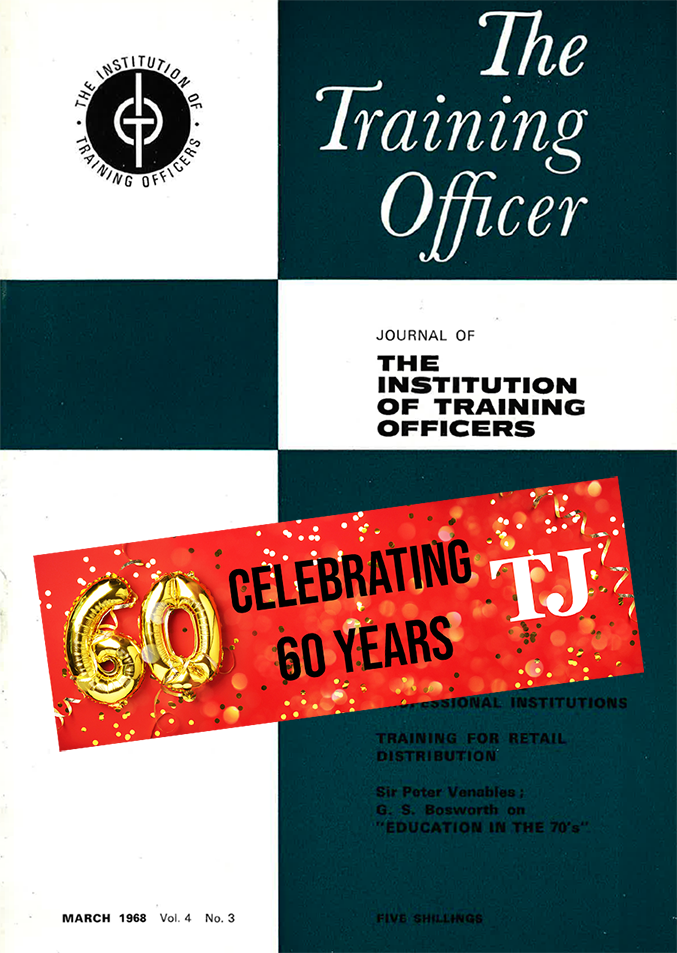
In March 1968, The Training Officer captured a profession coming of age. Between log books, training boards and debates about education’s purpose, the issue reveals how industrial-era concerns about standards, governance and real performance improvement still echo through today’s learning strategies, data systems and skills conversations for L&D professionals worldwide.
The Training Officer magazine from March 1968 is the second scan from the archives to celebrate 60 years of TJ’s work in learning in development. It feels like a snapshot of L&D at the moment it was trying to grow up as a profession. The editorial, Beware the Battle, positions the training officer in the crossfire between production pressures, new Industrial Training Board requirements and emerging educational ideals. It warns against being dragged into bureaucratic skirmishes and urges a focus on real improvement in people’s capability rather than simply satisfying schemes and inspections. From a modern perspective, it’s the same tension we see today between compliance training, data dashboards and genuinely improving performance.
A long central feature, Aims for the Future, reports on the Institution’s conference: Education in the 70’s. Sir Peter Venables and G. S. Bosworth debate the roles of universities, technical colleges and industry in preparing people for work. They argue about liberal studies versus specialised skills, the rise of polytechnics, and the need for education to stay close to industrial reality. The language is of “manpower” and “industry’s needs”, but underneath is a live question we still wrestle with: how do you balance broad human development with job-ready skills in a volatile economy, without reducing people to units of labour?
A Training Log Book is strikingly practical. It lays out, in meticulous detail, how apprentices should record daily tasks, machines used and lessons learned, complete with sample forms. It is an analogue learning record store and reflection tool, decades before LMSs and digital portfolios. Modern L&D would recognise the intent: make learning visible, encourage learner ownership and give managers clearer data.
Finally, the article on Industrial Training: The Roles of the Training Boards and the Professional Institutions shows early attempts at system-level governance and standards. The structures, names and gendered language have dated, but the core concerns about quality, funding and professional identity will sound very familiar to today’s practitioners.
Click the image below to load the PDF reader, and you can also join us at a celebratory conference in November 2025.
