
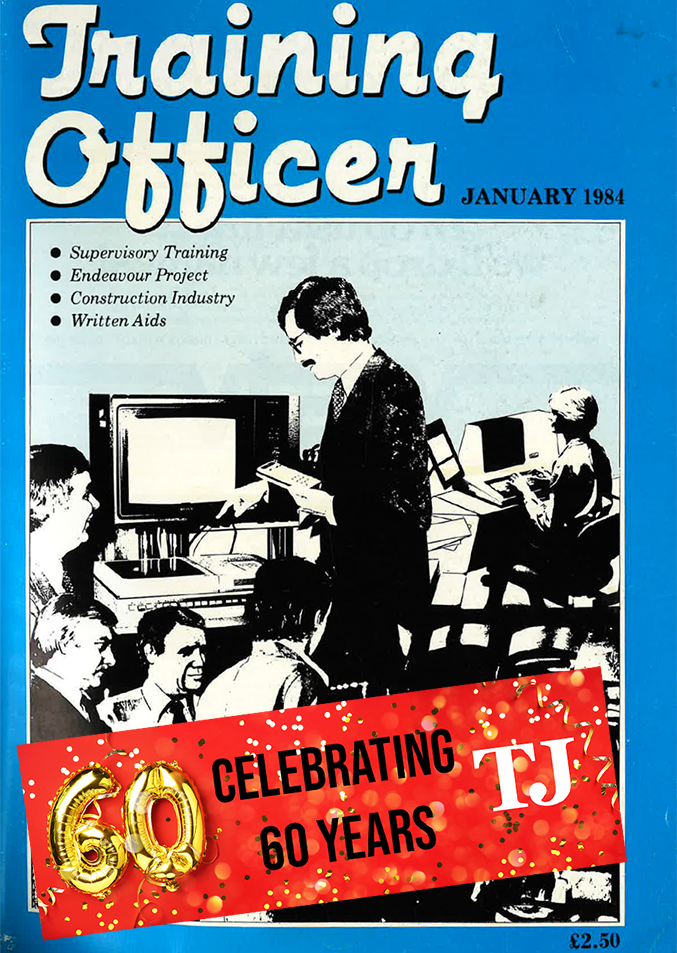
From youth training schemes and battles for women in engineering to microcomputers in the classroom, 1980s Training Officer pages show L&D wrestling with technology, equity and unemployment, while trying to keep learning human, practical and hopeful in the face of policy experiments and rapid workplace change for people at work.
The 1980s snippets from Training Officer capture a profession wrestling with inclusion, mass youth unemployment and the first wave of digital transformation… all at once. On the January 1984 pages, Baroness Platt argues passionately for women and girls to be welcomed into “non-traditional” jobs like engineering, and for mature women returners to get structured training, confidence-building and access to management development. Her closing line, “give women a chance and they will deliver the goods”, could sit unchanged in today’s diversity and equity discourse, even if the language and assumptions now feel dated.
Running through the 1984 issues is the Youth Training Scheme and the Manpower Services Commission’s “New Training Initiative”. Senior figures stress flexible pathways for school leavers, employer partnerships and the need to monitor quality so young people aren’t treated as cheap labour. It’s hard not to hear modern echoes in today’s debates about apprenticeships, early careers pathways and the tension between skills development, funding targets and genuine opportunity for young people.
By early 1985, the cover themes have shifted decisively to “Computers in Training” and “Micro-electronics”. Geoffrey Holland talks about technology reshaping every sector and insists that technologists and trainers must stop working in “watertight compartments”. His plea to “remember the learner” when adopting new tools feels remarkably current in an era of AI platforms, virtual delivery, learning analytics and automation.
Brian Simpson’s article How to be a Computer Tutor is a fascinating artefact. He describes instructors wrestling with overhead projectors, nervous learners and the need to move beyond demonstrations to hands-on practice. The emphasis on reducing fear, designing active learning around real tasks and positioning the tutor as a facilitator rather than a lecturer aligns neatly with today’s evidence-informed approaches to digital skills and workplace learning.
Taken together, these pages show L&D trying to humanise big policy schemes and emerging technologies. The questions they ask about access, equity, quality and learner-centred design are exactly the ones we still need to keep asking, now with far more powerful tools, and much less excuse not to act on the answers.
Click the image below to load the PDF reader, and you can also join us at a celebratory conference in November 2025.
