
A timeless framework for modern challenges, Action-Centred Leadership still offers leaders a clear way to balance results, relationships and individual needs under intense modern pressure. Steve Macaulay shows how John Adair’s enduring three-circle model remains a practical diagnostic and leadership tool for today’s complex organisational realities, no matter your seniority.
Action-Centred Leadership is a common starting point in the leadership L&D toolkit. Its creator, John Adair, passed away last year, yet he leaves behind a lasting legacy of a powerful working tool: three interlocking circles representing Task, Team, and Individual.
The strategic allocation of attention – perfectly suited to today’s world of remote working, high pressure, and organisational turbulence.
Though some view Action-Centred Leadership (ACL) as a “basic” model surpassed by modern theories and modern times, this is a misconception. ACL was originally developed in the 1970s for the military with a core principle: The strategic allocation of attention – perfectly suited to today’s world of remote working, high pressure, and organisational turbulence.
A framework built for action
ACL treats leadership as a practical guide for concrete action. It is driven by three fundamental truths:
- The Task must be accomplished
- The Team must function effectively and harmoniously
- The Individual must be energised, supported, and developed
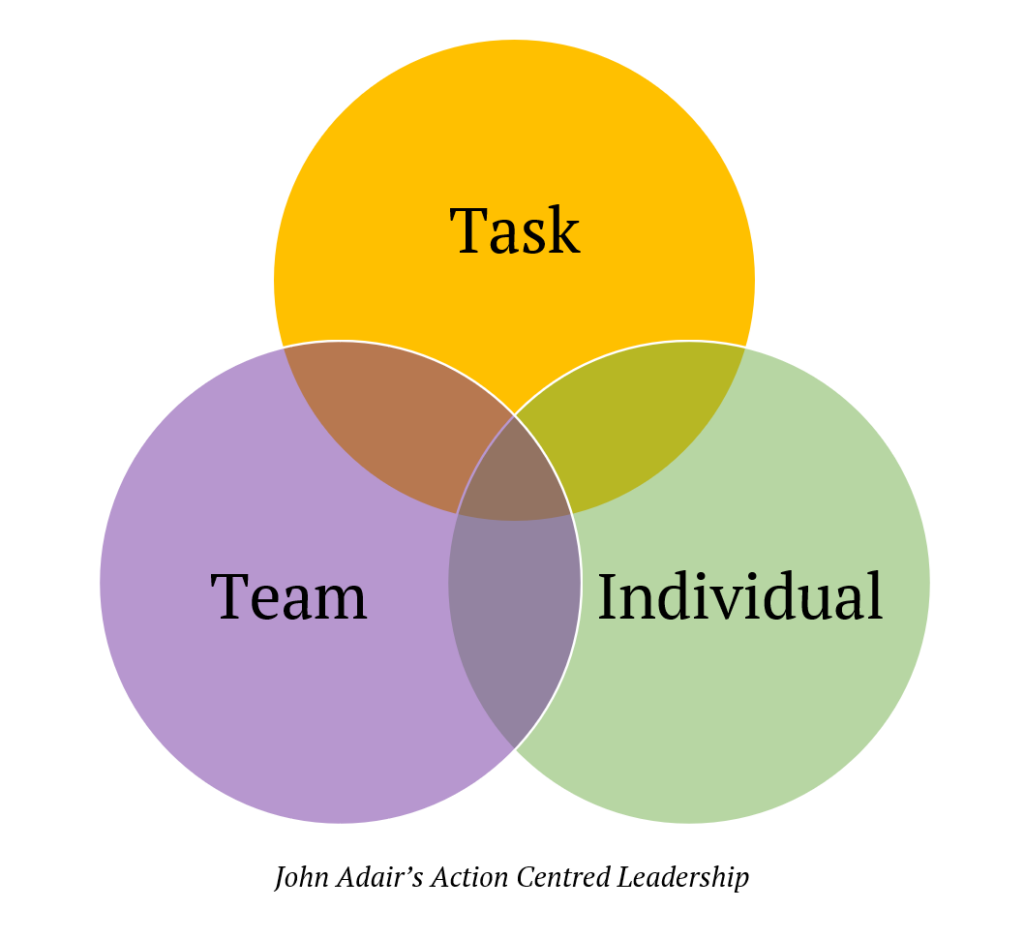
Effective leadership requires the continuous judgment to balance these three interdependent domains. If you overlook one, the others inevitably suffer, leading to poor results, low morale, or burnout.
The power of simplicity
ACL’s primary strength is its unpretentious focus. Rather than trying to cover every facet of leadership theory, it identifies the three things a leader must manage. Many leadership failures stem from an imbalance:
| Focus imbalance | Consequence |
| Excessive task focus | Often causes pressure, fatigue, and collective exhaustion- a common problem today |
| Over-attention on team | Can create superficial harmony while potentially sacrificing results |
| Disproportionate individual focus | Can lead to scattered priorities and a lack of overall direction |
For coaches and L&D professionals, ACL is a rapid diagnostic tool. It allows leaders to quickly identify which area is being neglected and make conscious corrections.
Case study: The healthcare manager
Consider a senior healthcare manager leading a high-pressure service transformation.
- The Task: Performance metrics are being monitored meticulously
- The Team: Meetings are on schedule, but tension is rising
- The Individual: Absenteeism and people leaving is up, and at least one key colleague is showing signs of burnout
By using ACL as a lens, in a coaching session the manager realises that the relentless focus on the Task has come at the cost of the Individual. Rebalancing, by reallocating duties and acknowledging the pressure, allows the team to recover and successfully complete the project. No complex intervention was needed; only a conscious shift in attention.
ACL for senior leaders
ACL is often underused by senior executives, yet it becomes more valuable as complexity increases. Senior leaders rarely lack expertise; they lack capacity and prioritisation. L&D practitioners should reposition ACL as:
- A reflective discipline rather than introductory content
- A diagnostic tool for authentic leadership dilemmas
- A shared vocabulary for productive internal conversations
At a senior level, the circles can even be scaled up: Task becomes strategic imperatives; Team becomes organisational culture; and Individual becomes stakeholder engagement and talent development.
Why ACL still works
In a crowded market of leadership theories, ACL still stands out, because it is:
- Memorable: Leaders internalise the three circles instantly
- Immediate: It can be applied to everyday situations without training manuals
- Transparent: It offers a practical way to manage trade-offs and compromises
While leadership today involves more complexity, such as digital transformation and distributed teams, the core challenge remains the same: achieving results through people while maintaining their commitment.
ACL is not just an entry-level theory, it is a disciplined, simple, and enduring model. It deserves a prominent place in any modern leadership portfolio.
Steve Macaulay is an Associate of Cranfield Executive Development
