
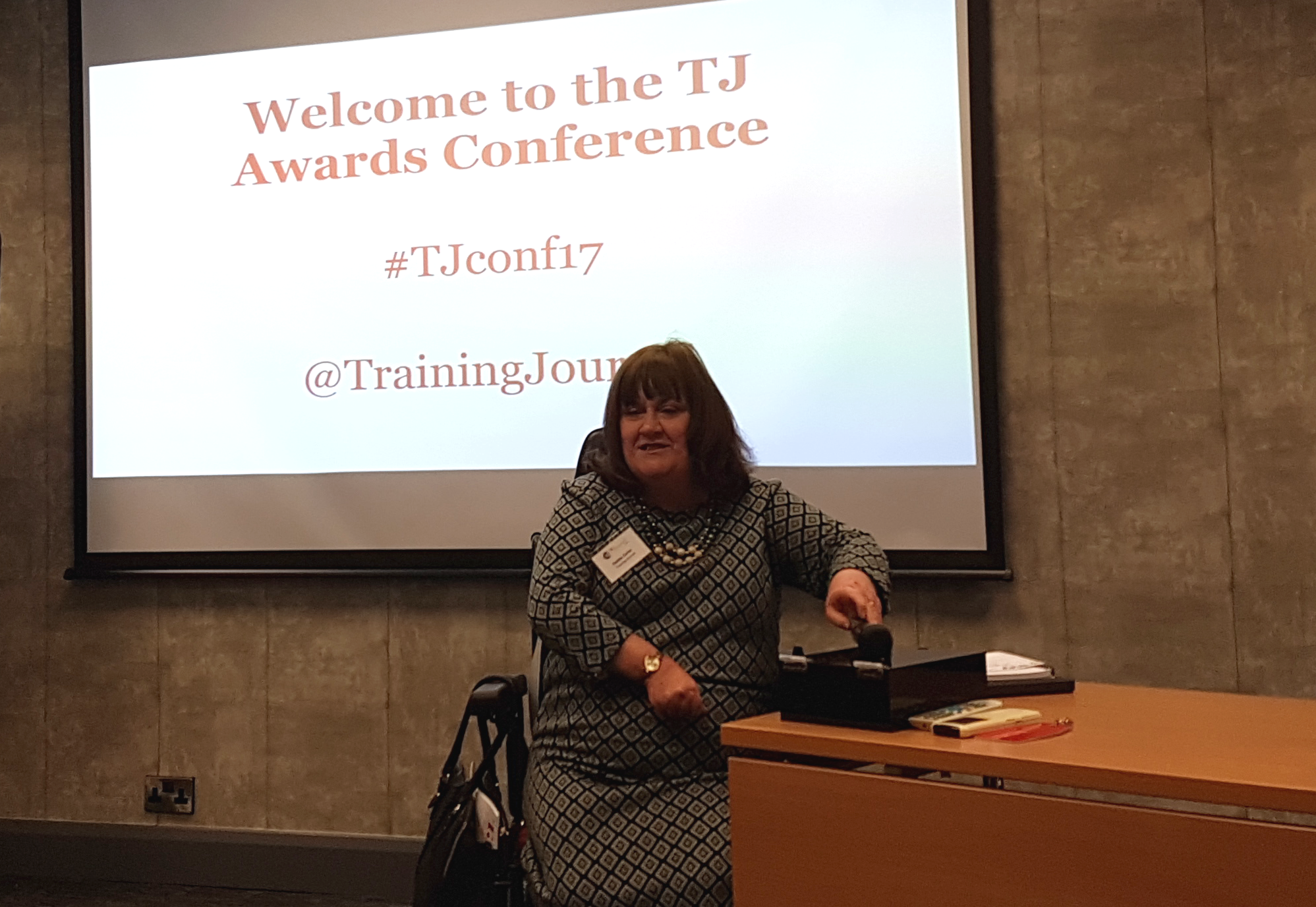
Jon talks to editor-in-chief of TJ, Debbie Carter, about her past, present and future.
Read her final piece as editor here: https://www.trainingjournal.com/articles/opinion/reflections-career
Transcript
From YouTube captions, formatted by ChatGPT in 2026:
John: Let’s do this. Okay, okay. Welcome, Debbie Carter, to the TJ podcast. For people who don’t know, though they’ll be few and far between, tell us who you are, your job title and a bit about you before we kick off.
Debbie: Okay. Well, my job title is Editor-in-Chief of Training Journal, TJ. I’ve been in this role for quite a long time, and today is my final day.
John: It is your final day, and we’re here to talk about that.
What has changed at TJ?
John: My first question, Debbie: what’s different and what’s the same about the TJ that you joined in the late 1990s?
Debbie: Well, I joined TJ in 2001, but I was part of the company that had TJ from the moment it was purchased from Malabone Press. That was in 1998, I think, when Fenman acquired it.
Debbie: Quite a lot has changed. If you think of it today, it’s now a purely digital project. At that time, it was a print-based magazine, with a very basic website and an affiliated online moderated forum called UK HRD. I think it might have been one of the first chat forums in the UK.
Debbie: It has changed a lot in the intervening years. It changed name from Training Officer, which it was when we bought it. That was appropriate because everybody who subscribed was either a Training Manager or Training Officer, but we thought it sounded a bit militaristic. We changed it to Training Journal, and later it became TJ.
Debbie: I think the editorial focus changed as well. Initially, it was very practical, how-to material for trainers. It focused on the training cycle: needs analysis, design, delivery, assessment and evaluation. We also covered a lot around soft skills, but the focus was on training trainers.
Debbie: That gradually changed over the years. Now we are giving people who are less often called trainers, and more often developers, Business Partners, coaches, talent professionals and a whole raft of other job titles, different types of skills. It has changed quite dramatically.
The happiest parts of working at TJ
John: We’re not going to talk too much about the sad times, so the next question is: what has made you happiest working at TJ?
Debbie: Lots of things, really. I think two main things stand out.
Debbie: The first is the project we did from about 2005 for three or four years called L&D 2020. We had seen changes in the job titles of our readership and realised that many were no longer doing what they originally had, which was delivering training as a largely transactional process.
Debbie: I remember talking to Don Taylor about this. On his first day in a training department, he went through the gates and found the factory and offices on one side, while the training department was in a little shed in the corner. That was very much how training was 20 years ago. It was not embedded in the business. It was essentially an order taker for Line Managers.
Debbie: That was clearly changing because we were seeing titles such as Business Partner. We began looking at what the future might look like through scenario planning. The project was called L&D 2020, which is quite ironic given what happened in 2020.
Debbie: Actually, I think 2020 was the tipping point that made a lot of what we were talking about happen. It was forced on us by the pandemic, but we had said that learning would become heavily driven by technology and would involve understanding learners through neuroscience, psychology, wellbeing and many of the things people talk about now.
Debbie: It was a very rewarding project. We also ran many focus groups about what was emerging, which was a great way to connect with practitioners. So often, you speak to contributors who may be suppliers or thinkers, but not necessarily people working inside large organisations.
Debbie: It gave us a view of what was happening there. For me, it provided enormous insight into the industry and how individuals work within different sectors. That was really valuable.
Debbie: The second great thing about working at TJ was the people. Not just my colleagues, although I have had many lovely colleagues over the years who were marvellously supportive and kind, but the industry more broadly.
Debbie: As a permanent wheelchair user who has been in the world of work since the late 1970s, it was refreshing to work for Fenman and subsequent companies, attend events and meet people in the industry because they were so inclusive. I didn’t feel that I didn’t belong.
Debbie: In many organisations before that, it had been difficult to make your mark because you couldn’t join in with everything. Things were difficult, and perhaps the support was not available then in the way it is now.
Debbie: For whatever reason, perhaps because HR and L&D tend to lead the inclusion and diversity agenda, people in the profession are often more attuned to connecting with others. That was an eye-opener for me.
Debbie: The world generally has changed, but I don’t think it has changed as much as it should have. There are still major barriers to inclusion. At TJ, it was very much about feeling part of something. L&D people made you feel extremely welcome. They are very generous with their time, thoughts and ideas. Those are probably the two main things, John.
John: This isn’t an excursion we planned, but I agree. The L&D community is, in the main, an incredibly generous and lovely group of people.
John: To use Twitter as a microcosm of a bigger picture, there are different tribes within a social network: film Twitter, football Twitter and so on. People in L&D Twitter are really positive, encouraging and supportive. I think that’s really good.
Debbie: Yes. I think people gravitate towards L&D because they care about people, and that is really nice.
Debbie: Before this, I worked at the Legal Services Commission with solicitors and barristers, and they are adversarial. Your whole day could be spent dealing with people who weren’t collaborative and didn’t want to listen. They wanted to argue about why their client needed legal aid immediately, regardless of the rules that meant you couldn’t provide it.
Debbie: That is their way of working generally. Apologies to all the nice barristers out there. There were lovely ones as well, don’t get me wrong, but much of the day was taken up with that kind of customer service in a professional services environment.
John: That’s fine. It’s your interview.
What should L&D do away with?
John: Okay, next question. What would you do away with from the world of L&D? It could be a piece of terminology or an entire area of the training industry. What are you not such a fan of?
Debbie: It would be difficult to answer that after I’ve just said how wonderful everybody within it is. I don’t think there is much I would change or get rid of.
Debbie: I do think people in L&D love models and acronyms, and I sometimes find those a little strained or tenuous. Articles come in about the 17 Ps of coaching, or something similar. That is an exaggeration, of course, but people like to shoehorn their ideas into a framework or a nice word, and sometimes I don’t think it works.
Debbie: Some have become mainstream and work well: the GROW model from John Whitmore, SMART objectives, SWOT analysis and PEST analysis. Those are useful acronyms, but many others are not very good.
Debbie: The other issue is not something to take away, but something I’m a little sorry about. Across L&D websites, events and articles, we talk about practitioners becoming more business-centric. A proportion are certainly making those moves, but I think a large number are still more tied to pedagogy than to what they are trying to achieve.
Debbie: That still needs work. I hope we can continue helping people recognise that understanding how people learn and understanding particular skills are vital, but the most important thing is knowing what your business is about and giving people the ability to support it.
Debbie: To quote Brian Murphy from your interview the other day, he talked about the vaccination programme. A programme that would normally take 10 to 15 years was completed in about 10 months. People had to unlearn many of the things they had previously believed were the only way to do it.
Debbie: That is key. L&D people need to challenge people in their organisations to let go of old approaches and embrace new ways of doing things. I still think a large proportion of people are resistant to that.
John: Agreed, agreed.
Words of wisdom
John: Obviously, Debbie, we’re going to stay in contact in various ways. Maybe I’ll even come and see you when we’re allowed to do that.
Debbie: That might be a long way off yet.
John: True. But for the purposes of drama, here’s my last question: give me some words of wisdom to take forward into the darkness without you.
Debbie: The darkness? You just told me about a new light you’re getting. You’re not going to be in the dark, are you?
John: I have got a new light. It’s very exciting. It’s a smart light, though, so I need to install the app and learn all that stuff. Modern-life problems.
Debbie: Well, you’ll have to blog about it or something, just to keep us informed.
John: I will.
Debbie: Anyhow, you’re not going to be alone because you have this vast network of people who will support you. As I said before, the industry is incredibly generous.
Debbie: I know you’re working on your own, but reach out to people. Ask for help and support, and I know you will get it. I’m not going anywhere. I’m still around. I know I’m in my 60s, but I’ve not pegged it yet, so if you have any questions, come and talk to me.
Debbie: I’m happy to be a sounding board. You’ve got Jo, who is a marvellous resource, and Kate. You are now omnipotent, as Jo said. You’re the glue that holds it all together.
Debbie: I recruited you four years ago because I knew you had the talent we needed for the future, and I know you’re a safe pair of hands. I have no doubt about that.
John: Cool. Do you have any concerns about the future?
Debbie: Not for me. I have concerns about the future for businesses as a whole.
Debbie: Going back to L&D 2020 and the work 15 years before that, calling it L&D 2020 wasn’t prescient in the ways people might have thought. Changes were accelerated last year for obvious reasons.
Debbie: I’d like to focus on the things that are going to change for the better, but businesses still have a great deal to understand about how they will operate, both as businesses and as organisations full of people. They need to understand people’s concerns about how and where they want to work, balance and related issues. There is a lot of uncertainty generally.
Debbie: To return to a refrain we’ve used several times before, there has always been uncertainty. As you said in your final piece, we’ll deal with it. You can’t do anything else.
Debbie: There’s a quote I’ve probably seen hundreds of times in articles over 20 years: ‘Change is the only constant.’ I think it was Confucius who said that. Who knows? There are so many quotations attributed to people. I think it might have been a Chinese man a long time ago.
Debbie: We all have to deal with change. I worry about my grandchildren and the future, but then I look at them and think, ‘I don’t know why I’m worrying. They’ll deal with it, because it’s their world, not mine any more.’
John: The children of the future, as George Benson once sang.
John: Debbie, I know you’ve got to go. We could carry on, but I just want to say that it has been a pleasure working with you and for you. Thank you for everything you’ve done for TJ.
Debbie: I intend to carry on helping it whenever I can. You know that. It has been a joy. I’ve loved it.
Debbie: Everybody has been so supportive and wonderfully innovative in their approaches. I’ve seen all sorts of things over the years and met so many lovely people, famous and not famous. Have I met anybody infamous? No, I don’t think so.
Debbie: It has been a real privilege. As I said before, I’ve enjoyed it immensely. Thank you, John, for giving me the opportunity to say goodbye properly.
John: No problem. I’m sure we’ll be talking again in a couple of days, but for now, it has been a pleasure. Bye-bye.
